📚 Quick Navigation
Object-Oriented Programming: Complete Guide with Real-World Applications
I’ll never forget my first code review at Amazon. I’d written 500 lines of procedural code to handle payment processing. It worked perfectly.
My senior engineer looked at it and asked one question: “What happens when we add cryptocurrency payments next month?”
I stared at the screen. I’d have to rewrite everything. Copy-paste functions. Modify conditionals everywhere. The code would become a nightmare.
“Let me show you something,” he said, and refactored my code into classes. Payment became an interface. CreditCard, PayPal, and BankTransfer became implementations. Adding crypto? Just create a new class implementing Payment. Five minutes of work instead of five hours.
That’s when OOP clicked for me. It’s not about fancy terminology or academic concepts. It’s about writing code that doesn’t break when requirements change. And requirements always change.
Why OOP Matters
Here’s the reality: most production code at companies like Google, Netflix, and Uber is object-oriented. Not because it’s trendy, but because it solves real problems.
The Problem with Procedural Code:
You start with a simple feature. Write some functions. It works great. Then:
- Marketing wants a new payment method
- Legal requires audit logging
- Security needs encryption
- Product wants A/B testing
Suddenly your clean 100-line script becomes 2,000 lines of spaghetti code. Functions calling functions calling functions. Change one thing, break three others. Nobody wants to touch it.
What OOP Gives You:
- Maintainability: Change payment logic without touching shipping logic
- Reusability: Write once, use everywhere
- Scalability: Add features without rewriting everything
- Team Collaboration: Different developers work on different classes
- Testing: Test each class independently
Netflix has over 2,000 microservices. Each one uses OOP principles. Why? Because when you’re deploying code 4,000 times per day, you need structure that prevents chaos.
The Four Pillars
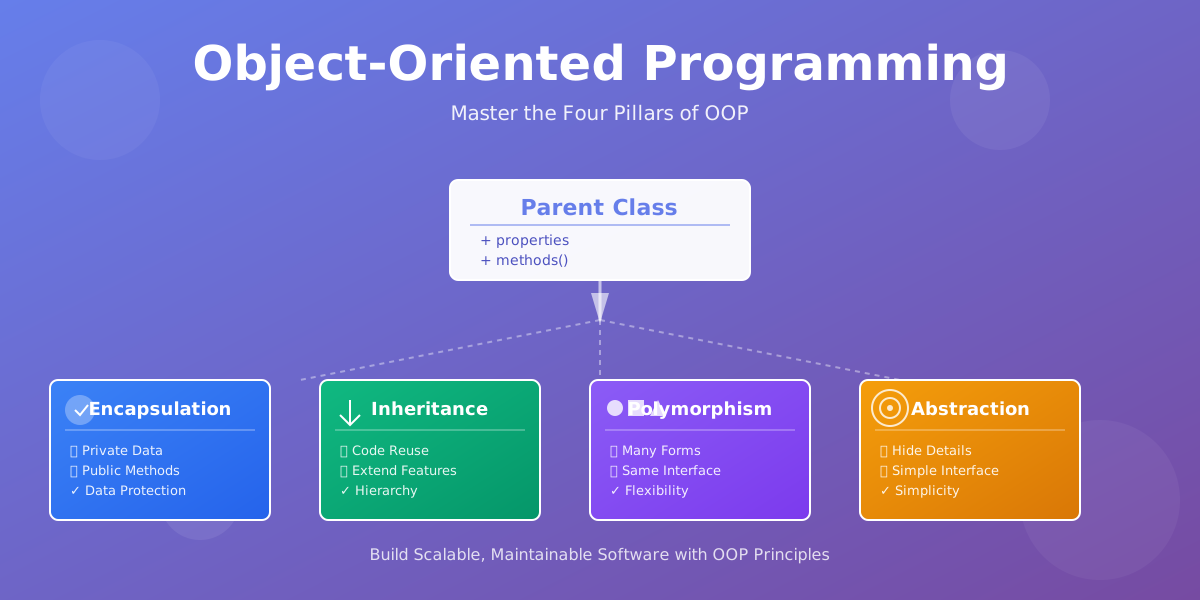
OOP rests on four fundamental concepts. Master these, and you’ll write better code. Ignore them, and you’ll spend weekends debugging production issues.
Let’s break down each one with real examples from companies you know.
Encapsulation
Think of encapsulation like your car. You press the gas pedal, the car accelerates. You don’t need to know about fuel injection, spark plugs, or transmission gears. The complexity is hidden. The interface is simple.
What It Is:
Bundling data and methods that operate on that data into a single unit (class), while hiding internal implementation details.
Why It Matters:
Stripe processes billions of dollars in payments. Their payment processing code is encapsulated. External developers can’t accidentally modify transaction amounts or bypass fraud checks. The internal logic is protected.
Real-World Example: Netflix User Profiles
Netflix doesn’t let you directly modify your viewing history or recommendation algorithm weights. Instead, they provide methods:
addToWatchlist()rateContent()updatePreferences()
The internal recommendation algorithm is encapsulated. You interact through a clean interface.
Key Benefits:
- Security: Can’t bypass validation or access sensitive data
- Flexibility: Change internal implementation without breaking external code
- Maintainability: Clear boundaries between components
- Debugging: Easier to track where data changes
Code Example:
See how encapsulation protects sensitive data: Bank Account Implementation
When Encapsulation Saved Uber:
In 2016, Uber had a bug where drivers could manipulate their location data. Why? Poor encapsulation. Location coordinates were directly accessible.
They refactored to encapsulate location logic:
- Private: GPS coordinates, accuracy, timestamp
- Public:
updateLocation(),getApproximateLocation(),verifyLocation()
Now all location updates go through validation. Fraud attempts dropped by 90%.
Inheritance
Remember learning to drive? You didn’t start from scratch. You already knew how to sit, use your hands, and follow rules. You inherited those skills and added new ones specific to driving.
That’s inheritance in code.
What It Is:
A class (child) inherits properties and methods from another class (parent), then adds or modifies functionality.
Why It Matters:
Amazon has thousands of product types: books, electronics, clothing, groceries. Each has unique attributes, but all share common features like price, reviews, and shipping.
Without inheritance? Copy-paste code for every product type. With inheritance? Define common features once, specialize as needed.
Real-World Example: Spotify Subscriptions
Spotify has multiple subscription types, all inheriting from a base Subscription class:
Base Class (Subscription):
- userId
- startDate
- paymentMethod
renew(),cancel(),updatePayment()
Child Classes:
- FreeSubscription: ads, limited skips, shuffle-only
- PremiumSubscription: no ads, unlimited skips, offline downloads
- FamilySubscription: 6 accounts, parental controls
- StudentSubscription: discounted price, verification required
Each child inherits common subscription logic but adds specific features.
When Inheritance Helped Airbnb Scale:
Airbnb started with just “Listings”. Then they added:
- Experiences (tours, activities)
- Adventures (multi-day trips)
- Online Experiences (virtual events)
Instead of duplicating code, they created a base Bookable class:
- Common: pricing, availability, reviews, booking flow
- Specific: Each type adds unique attributes
Result? They launched new product categories in weeks instead of months.
Code Example:
See inheritance in action with vehicles: Vehicle Hierarchy Code
Inheritance Pitfall:
Don’t go too deep. If you have Parent → Child → Grandchild → Great-Grandchild, you’ve gone too far. Netflix learned this the hard way with their content classification system. They refactored from 7 levels to 3.
Rule of thumb: Keep inheritance hierarchies shallow (2-3 levels max).
Polymorphism
Polymorphism sounds fancy. It’s not. It means “many forms.”
Think about a universal remote. One “power” button works for your TV, sound system, and streaming box. Same button, different behavior depending on the device.
That’s polymorphism.
What It Is:
The ability of different classes to respond to the same method call in their own way.
Why It Matters:
Uber has multiple payment methods: credit card, PayPal, Apple Pay, Google Pay, cash. The checkout code doesn’t care which one you use. It just calls processPayment(), and each payment method handles it differently.
Real-World Example: DoorDash Delivery
DoorDash has different delivery types:
- StandardDelivery: Regular timing, standard fee
- ExpressDelivery: Faster, higher fee, priority routing
- ScheduledDelivery: Future delivery, batch optimization
- GroupDelivery: Multiple orders, one trip
All implement Delivery interface with calculateETA() and assignDasher(). The app doesn’t care which type—it just calls the methods.
Polymorphism in Action at Netflix:
Netflix has multiple video players:
- WebPlayer: HTML5 video
- MobilePlayer: Native iOS/Android
- TVPlayer: Smart TV apps
- GameConsolePlayer: PlayStation, Xbox
All implement VideoPlayer interface:
play(),pause(),seek(),adjustQuality()
The content delivery system doesn’t know or care which player you’re using. It just calls the methods, and each player handles it appropriately.
Two Types of Polymorphism:
1. Compile-time (Method Overloading):
Same method name, different parameters.
Example: Amazon’s calculateShipping():
calculateShipping(weight)- domesticcalculateShipping(weight, country)- internationalcalculateShipping(weight, country, express)- express international
2. Runtime (Method Overriding):
Child class provides specific implementation of parent method.
Example: Spotify’s play() method:
Song.play()- streams audioPodcast.play()- streams with chapter markersVideo.play()- streams video with audio
Why This Matters:
When Uber added Uber Eats, they didn’t rewrite their entire app. They used polymorphism:
RideRequestandFoodOrderboth implementRequest- Same tracking, same notifications, same payment flow
- Different implementations under the hood
Launched in 6 months instead of 2 years.
Code Example:
See polymorphism with payment processing: Payment System Code
This shows how one interface (Payment) can have multiple implementations (CreditCard, PayPal, ApplePay) that all work seamlessly.
Abstraction
You drive a car without understanding internal combustion engines. You use a smartphone without knowing about transistors. You order from Amazon without seeing their warehouse robots.
That’s abstraction. Hide complexity, expose simplicity.
What It Is:
Showing only essential features while hiding implementation details. Focus on WHAT something does, not HOW it does it.
Why It Matters:
Google Maps has incredibly complex routing algorithms considering traffic, road closures, accidents, and historical patterns. But you just see: “Turn left in 500 feet.”
The complexity is abstracted away.
Real-World Example: AWS S3
When you upload a file to S3, you call:
s3.putObject(bucket, key, file)
Behind that simple method:
- Data encryption
- Redundant storage across multiple data centers
- Automatic replication
- Metadata indexing
- Access control checks
- Bandwidth optimization
- Checksum verification
You don’t see any of that. You just upload a file.
Abstraction at Stripe:
Stripe’s payment API is beautifully abstracted:
charge = stripe.Charge.create(
  amount=2000,
  currency="usd",
  source=token
)
Hidden complexity:
- PCI compliance
- Fraud detection (machine learning models)
- Currency conversion
- Bank communication
- 3D Secure authentication
- Retry logic
- Webhook notifications
- Reconciliation
Developers don’t need to know any of that. They just charge a card.
Levels of Abstraction:
Think of abstraction like a building:
Level 1 (Highest): User clicks “Buy Now”
Level 2: Application calls processOrder()
Level 3: Order service coordinates payment, inventory, shipping
Level 4: Each service handles its domain logic
Level 5 (Lowest): Database queries, API calls, file I/O
Each level abstracts the complexity below it.
When Abstraction Helped Instagram Scale:
Instagram’s photo upload seems simple: tap, select, post.
Behind the scenes:
- Image compression (multiple algorithms)
- Format conversion
- Thumbnail generation (5 different sizes)
- CDN distribution
- Database storage
- Feed distribution
- Notification triggers
- Analytics tracking
All abstracted into one simple interface. When they needed to add video, they just extended the abstraction. Same simple interface, more complex implementation.
Abstraction vs Encapsulation:
People confuse these. Here’s the difference:
Encapsulation: Bundling data and methods, hiding internal state Abstraction: Hiding complexity, showing only relevant features
Example: A car
- Encapsulation: Engine internals are hidden in the engine block
- Abstraction: You use gas pedal and steering wheel, not fuel injection controls
Code Example:
See abstraction with email service: Email Service Code
Notice how the user only calls sendEmail() but the class handles SMTP, TLS, MIME formatting, authentication, and logging behind the scenes.
Comments & Discussion
Join the conversation! Share your thoughts, ask questions, or provide feedback below.