Linked Lists: The Complete Guide to Understanding and Mastering Dynamic Data Structures
Ever been frustrated when you’re trying to insert a new item in the middle of a packed array, and suddenly you need to shift thousands of elements just to make room? Or wondered how your music streaming app can instantly add a song anywhere in your 500-song playlist without breaking a sweat?
That’s where linked lists shine. While arrays are like a row of numbered parking spaces where everyone has to shuffle around when someone new arrives, linked lists are more like a treasure hunt where each clue points to the next location. No shuffling, no predetermined size limits, just pure dynamic flexibility.
If you’ve ever built a feature where users can reorder items, manage dynamic lists, or implement undo functionality, you’ve probably needed the power of linked lists without even realizing it. They’re the unsung heroes behind everything from browser history to complex data processing pipelines.
The Problem with Static Thinking
Picture this: you’re building a task management app, and you decide to use an array to store tasks. Everything works great until users start complaining. “Why does it take forever to add a task at the beginning of my list?” “Why can’t I have more than 1000 tasks?”
Here’s what’s happening under the hood. When you insert at the beginning of an array with 1000 elements, the computer has to:
- Create space for the new element
- Move all 1000 existing elements one position to the right
- Finally insert your new element
That’s 1000 operations just to add one item. Scale that to 10,000 or 100,000 items, and you’ve got a performance nightmare.
The real kicker? You had to decide upfront how big your array should be. Too small, and you run out of space. Too big, and you’re wasting memory on empty slots.
Questions You Should Ask
Before we dive into linked lists, think about these scenarios:
- How often do you need to insert or delete items from the middle of your collection?
- Do you know the maximum size of your data ahead of time?
- Is memory usage a concern in your application?
- Do you need random access to elements by index?
Your answers will determine whether linked lists are the right tool for the job.
Understanding Linked Lists
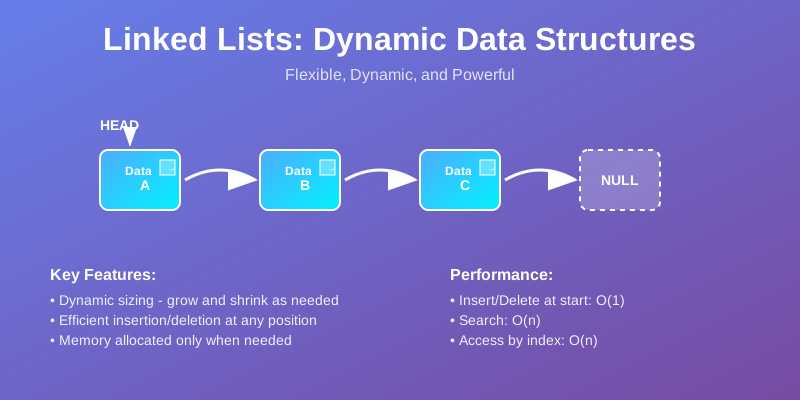
Think of a linked list like a scavenger hunt. Each clue (node) contains two things: the treasure (your data) and directions to the next clue (a pointer). You start at the first clue and follow the chain until you reach the end.
Unlike arrays where elements sit next to each other in memory like books on a shelf, linked list nodes can be scattered anywhere in memory. The magic is in the connections—each node knows exactly where to find the next one.
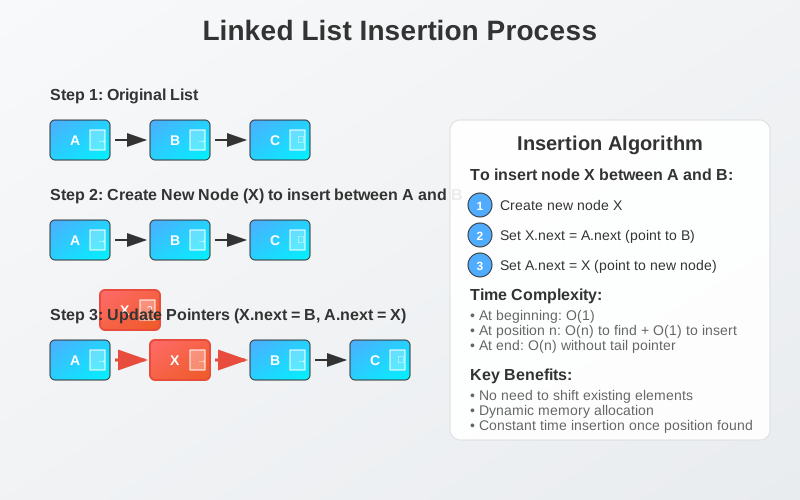
Here’s the beautiful part: adding a new node is like inserting a new clue in your scavenger hunt. You just need to:
- Create the new clue
- Point it to where the previous clue was pointing
- Update the previous clue to point to your new one
Three simple operations, regardless of whether your list has 10 items or 10 million.
Types of Linked Lists: Choosing Your Adventure
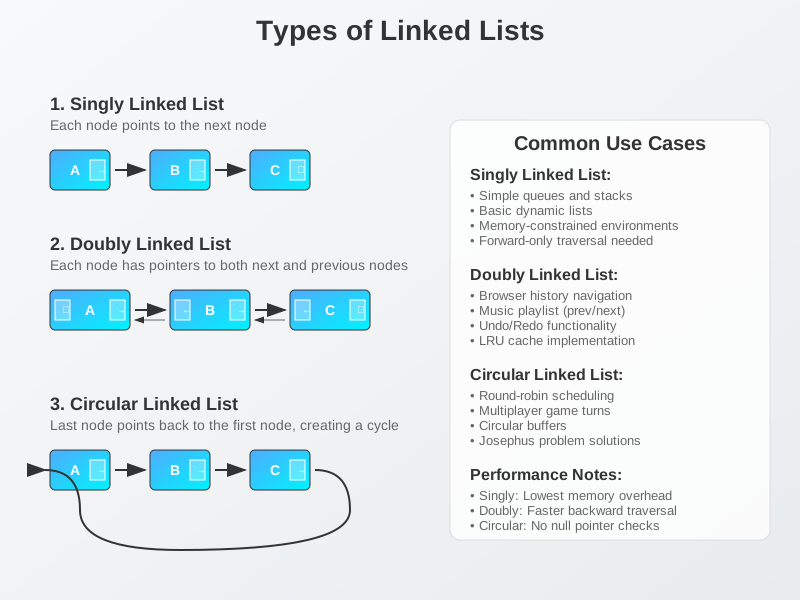
Singly Linked Lists: The Classic
This is your basic treasure hunt—each node points to the next one, and that’s it. Simple, memory-efficient, and perfect for most use cases.
When to use it:
- Building a simple queue or stack
- Implementing basic dynamic lists
- When memory is tight and you only need forward traversal
Real-world example: Browser history (simplified version). Each page you visit points to the next one you’ll visit.
Doubly Linked Lists: The Two-Way Street
Now each node has two pointers—one to the next node and one to the previous node. It’s like having a scavenger hunt where each clue also tells you where you came from.
When to use it:
- When you need to traverse in both directions
- Implementing features like “previous/next” navigation
- Building complex data structures like deques
Real-world example: Music playlist where users can skip forward or backward through songs.
Circular Linked Lists: The Never-Ending Story
The last node points back to the first node, creating an infinite loop. It’s like a scavenger hunt that never ends—when you reach the last clue, it sends you back to the first one.
When to use it:
- Round-robin scheduling algorithms
- Implementing circular buffers
- Games where players take turns in a cycle
Real-world example: Operating system process scheduling, where each process gets a turn and then cycles back to the first process.
The Honest Truth: Pros and Cons
Let’s be real about when linked lists shine and when they don’t.
What Linked Lists Do Brilliantly
Dynamic sizing: No need to declare size upfront. Your list grows and shrinks as needed, like a rubber band.
Efficient insertion/deletion: Adding or removing elements from the beginning or middle is lightning fast—just a few pointer updates.
Memory efficiency: Only allocate memory when you actually need it. No wasted space on empty slots.
Flexibility: Perfect for implementing other data structures like stacks, queues, and graphs.
Where Linked Lists Struggle
No random access: Want the 500th element? You’ll have to traverse through all 499 elements before it. Arrays let you jump directly there.
Memory overhead: Each node needs extra space to store the pointer(s). For small data types, this overhead can be significant.
Cache performance: Since nodes are scattered in memory, your CPU cache can’t help much. Arrays benefit from spatial locality.
Complexity: More complex to implement correctly than arrays, especially when dealing with edge cases.
The Bottom Line
Use linked lists when you’re doing lots of insertions and deletions, especially at the beginning or middle of your collection. Stick with arrays when you need fast random access or when memory overhead matters.
Common Operations: The Practical Stuff
Insertion: Adding New Elements
At the beginning: Create new node, point it to current head, update head pointer. Done in constant time.
At the end: Traverse to the last node, create new node, update the last node’s pointer. Takes linear time unless you maintain a tail pointer.
In the middle: Find the insertion point, create new node, update pointers. The finding takes time, but the actual insertion is constant.
Deletion: Removing Elements
From the beginning: Update head pointer to skip the first node, free the memory. Constant time operation.
From the end: Traverse to the second-to-last node, update its pointer to null, free the last node’s memory.
From the middle: Find the node before the one you want to delete, update its pointer to skip the target node, free the target’s memory.
Traversal: Walking Through the List
Start at the head, follow the pointers until you reach a null pointer (or back to the head in circular lists). Simple but takes linear time.
Search: Finding Specific Elements
Unfortunately, you’ll need to traverse the list until you find what you’re looking for. No shortcuts here—it’s a linear search operation.
Real-World Applications: Where You’ll Actually Use This
Undo/Redo Functionality
Ever wondered how text editors implement unlimited undo? Each action gets stored as a node in a linked list. Undo means traversing backward, redo means going forward. The dynamic nature of linked lists makes this elegant and memory-efficient.
Music Streaming Playlists
Spotify, Apple Music, and other streaming services use linked list concepts for playlists. Users can add songs anywhere, reorder them, and remove them without affecting the rest of the playlist. The dynamic sizing means playlists can be as long as users want.
Browser History
Your browser maintains a linked list of pages you’ve visited. The back button traverses backward through the list, while forward goes the other way. New pages get inserted at your current position, and everything after gets discarded.
Memory Management
Operating systems use linked lists to manage free memory blocks. When a program requests memory, the OS traverses its free list to find a suitable block. When memory is freed, it gets added back to the list.
Social Media Feeds
Twitter, Facebook, and LinkedIn use linked list concepts for timeline feeds. New posts get inserted at the beginning, and the feed can grow dynamically as users scroll. The chronological ordering maps naturally to a linked structure.
Implementation Gotchas: Learn from My Mistakes
Memory Leaks Are Real
Always free memory when deleting nodes. In languages without garbage collection, forgetting this will slowly eat up your system’s memory. I’ve seen production systems crash because of this exact issue.
Null Pointer Nightmares
Always check for null pointers before dereferencing. The number of times I’ve crashed programs by assuming a node exists when it doesn’t… let’s just say it’s a lesson you learn the hard way.
Edge Cases Will Get You
Empty lists, single-element lists, and operations on the last element are where bugs love to hide. Test these scenarios thoroughly.
Circular References
In doubly linked lists, be extra careful when updating pointers. It’s easy to create circular references that will crash your program or create infinite loops.
Performance Characteristics: The Numbers Game
Here’s the honest breakdown of linked list performance:
Insertion/Deletion at beginning: O(1) - Constant time, blazing fast Insertion/Deletion at end: O(n) without tail pointer, O(1) with tail pointer Insertion/Deletion in middle: O(n) to find position + O(1) to modify Search: O(n) - Linear search, no shortcuts Access by index: O(n) - Have to traverse from the beginning
Compare this to arrays: Random access: O(1) - Arrays win big here Insertion/Deletion at beginning: O(n) - Linked lists win Insertion/Deletion at end: O(1) - Tie (if array has capacity) Search in unsorted data: O(n) - Tie Search in sorted data: O(log n) with binary search - Arrays win
Advanced Patterns: Beyond the Basics
Skip Lists: The Fast Lane
Skip lists add express lanes to linked lists. Some nodes have multiple pointers that skip ahead, allowing faster traversal. It’s like having both local roads and highways in your scavenger hunt.
XOR Linked Lists: The Memory Saver
A clever trick where each node stores the XOR of the previous and next node addresses. This saves memory by using only one pointer per node while still allowing bidirectional traversal. It’s elegant but tricky to implement correctly.
Lock-Free Linked Lists: The Concurrent Champion
In multithreaded environments, you can implement linked lists that multiple threads can modify simultaneously without locks. This requires atomic operations and careful pointer manipulation, but the performance benefits can be huge.
When NOT to Use Linked Lists
Let’s be honest—linked lists aren’t always the answer.
Avoid them when:
- You need frequent random access to elements
- Memory usage is critical and your data is small
- You’re working with numerical computations that benefit from cache locality
- The overhead of pointers is significant compared to your data size
- You need to sort data frequently (arrays are much faster to sort)
Better alternatives:
- Dynamic arrays (like Python lists or JavaScript arrays) for most general-purpose needs
- Deques for double-ended operations
- Hash tables for fast lookups
- Trees for hierarchical data or when you need sorted access
Key Takeaways
Linked lists are like the Swiss Army knife of data structures—incredibly versatile but not always the best tool for every job.
They excel when you need dynamic sizing and frequent insertions/deletions, especially at the beginning or middle of your collection. They’re the backbone of many other data structures and algorithms you’ll encounter.
But they’re not magic. The lack of random access and memory overhead can be deal-breakers in certain scenarios. Like any tool, understanding when and how to use them is more important than just knowing how they work.
The next time you’re building a feature that involves dynamic lists, user-reorderable content, or undo functionality, consider whether linked lists might be the elegant solution you’re looking for.
The Bottom Line
Linked lists teach us that sometimes the most elegant solutions come from thinking differently about how we organize data. Instead of forcing everything into rigid, predetermined structures, we can create flexible, dynamic systems that adapt to our needs.
Whether you’re building the next great music streaming app or just trying to understand how your favorite software works under the hood, linked lists are a fundamental concept that will make you a better programmer.
Ready to dive deeper into data structures and algorithms? Explore more guides or connect with me to discuss your specific use cases.
Comments & Discussion
Join the conversation! Share your thoughts, ask questions, or provide feedback below.