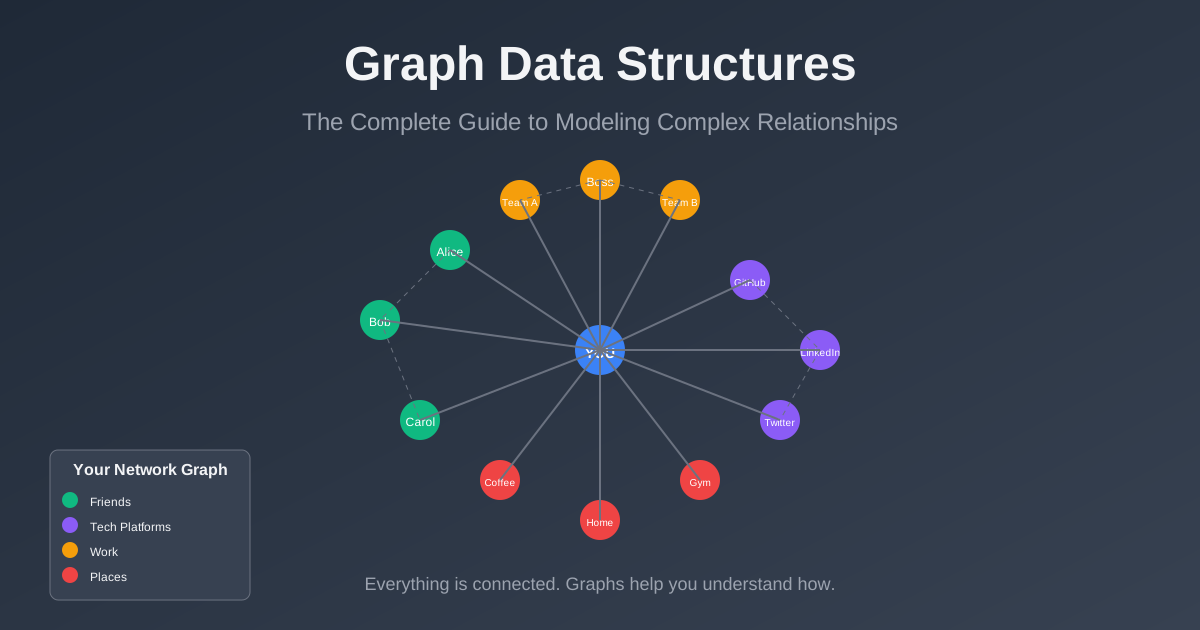
Graph Data Structures: The Complete Guide to Modeling Complex Relationships
Picture this: you’re building a social media app, and you decide to store friendships in a simple array. Alice is friends with Bob, Charlie, and Diana. Bob is friends with Alice, Eve, and Frank. Seems manageable, right?
Then your users start asking questions like “How many mutual friends do Alice and Bob have?” or “What’s the shortest path of connections between Alice and someone in Tokyo?” Suddenly, your neat little arrays become a nightmare of nested loops and inefficient searches.
Or maybe you’re building a project management system. Task A depends on Task B, but Task B can’t start until both Task C and Task D are done. Task C needs Task E, but Task E also depends on Task A. Wait, that’s a circular dependency that would break everything!
Here’s the thing: the real world isn’t made of neat lists or simple hierarchies. It’s a web of interconnected relationships, dependencies, and networks. And when you try to force that complexity into arrays or trees, you end up with code that’s slow, buggy, and impossible to maintain.
That’s where graphs come in. They’re not just another data structure—they’re the mathematical foundation that powers Google Maps, LinkedIn’s “People You May Know,” Netflix recommendations, and pretty much every complex system you interact with daily.
When Arrays and Trees Just Don’t Cut It
Let’s be honest about what happens when you try to solve graph problems with the wrong tools.
Say you’re using an array to track who’s friends with whom. Alice’s friends are at index 0: [Bob, Charlie, Diana]. Bob’s friends are at index 1: [Alice, Eve, Frank]. Looks clean in your code, but try answering this: “Are Alice and Eve connected through mutual friends?”
You’d need to loop through Alice’s friends, then loop through each of their friends, checking for Eve. That’s already O(n²) for a simple question. Now imagine Facebook’s 3 billion users asking “How am I connected to this person?” Your servers would melt.
Or maybe you tried using a tree structure for your org chart. Works great until someone has a dotted-line relationship to another department. Suddenly your clean hierarchy becomes a mess of special cases and workarounds.
Here’s what I’ve learned from years of building systems: when you find yourself writing code like “for each friend of each friend of each friend,” you’re probably solving a graph problem with the wrong data structure.
The Questions That Break Simple Structures
Before we dive into graphs, think about these scenarios:
- How do you find the shortest path between two points?
- What happens when relationships go both ways (or don’t)?
- How do you detect cycles that could break your system?
- Can you efficiently find all nodes within N steps of a starting point?
- What if your data has many-to-many relationships?
If these sound familiar, you need graphs.
Understanding Graphs: It’s Simpler Than You Think
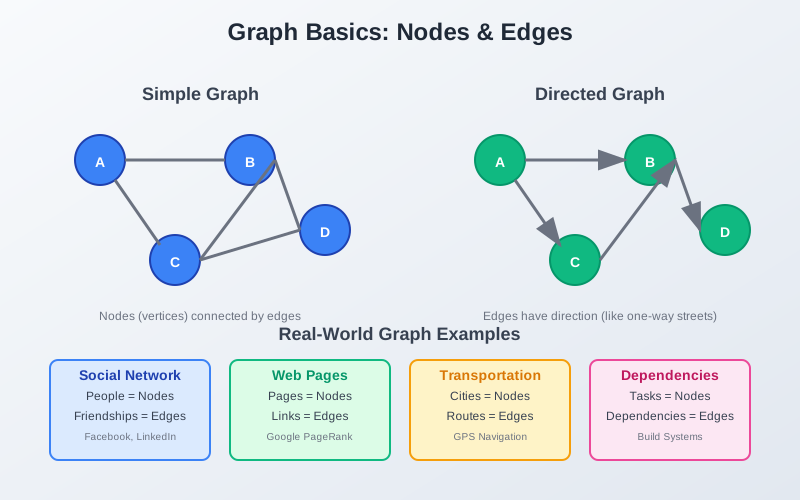
Forget the intimidating math terminology for a second. A graph is just a way to represent connections between things. Think of it like a map of your city, but instead of just roads and buildings, it can show any kind of relationship.
Each “thing” (we call them nodes or vertices) can connect to any number of other things through relationships (we call them edges). Your friend network? That’s a graph. The internet? Massive graph. Your company’s org chart with all those dotted-line relationships? Yep, graph.
Here’s what makes graphs powerful: they don’t impose artificial rules about how things connect. In an array, item 5 can only connect to items 4 and 6. In a tree, each child has exactly one parent. But in a graph? Anything can connect to anything, just like in real life.
The magic happens when you start asking questions about these connections:
- What’s the shortest path from A to B?
- Which node is the most connected (influential)?
- Are there any cycles that could cause problems?
- What’s the best way to visit all nodes?
These aren’t just academic questions—they’re the foundation of billion-dollar algorithms.
The Graph Family: Picking Your Flavor
Not all graphs are created equal. Let me break down the main types you’ll encounter, and more importantly, when to use each one.
Directed vs Undirected: Does Direction Matter?
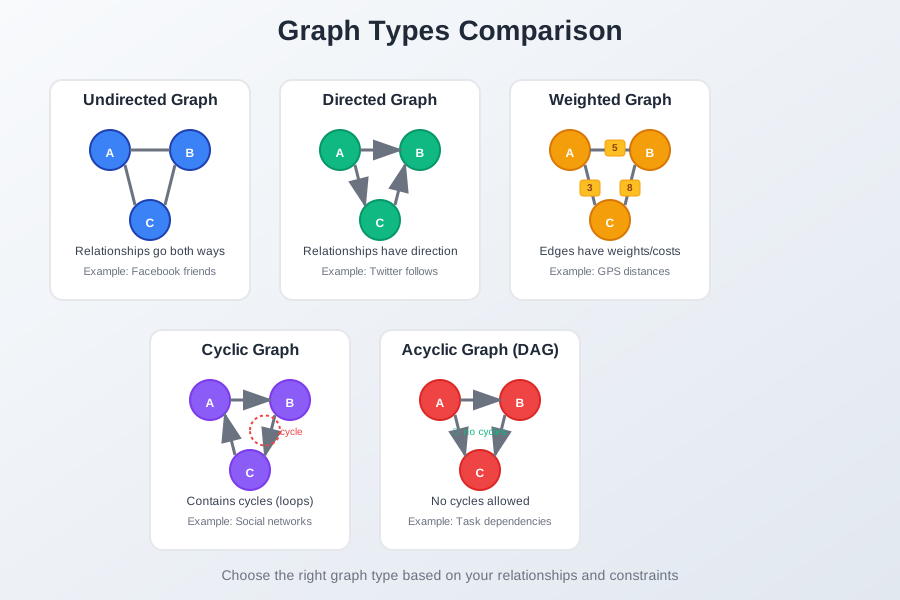
Think of undirected graphs like friendships on Facebook. If you’re friends with someone, they’re automatically friends with you. The relationship goes both ways.
Directed graphs are more like Twitter follows. You can follow someone without them following you back. The relationship has a direction, and that direction matters.
Use undirected graphs for:
- Social networks (mutual connections)
- Physical networks (roads you can travel both ways)
- Collaboration relationships
Use directed graphs for:
- Web links (Page A links to Page B, but not necessarily vice versa)
- Task dependencies (Task A must complete before Task B)
- Information flow systems
Real example: LinkedIn uses directed graphs for professional relationships. When you connect with someone, it’s mutual (undirected), but when you follow a company, that’s one-way (directed).
Weighted vs Unweighted: Is Every Connection Equal?
Unweighted graphs treat all connections the same. You’re either connected or you’re not.
Weighted graphs assign values to connections. Maybe it’s distance, cost, strength of relationship, or time required.
Use weighted graphs when:
- Distance matters (GPS navigation)
- Cost varies (flight prices between cities)
- Relationship strength differs (close friends vs acquaintances)
- Time is a factor (how long tasks take)
Real example: Uber’s routing system uses weighted graphs where roads are edges and intersections are nodes. The weights represent travel time, which changes based on traffic conditions.
Cyclic vs Acyclic: The Loop Question
Cyclic graphs allow loops—you can start at a node and eventually return to it by following edges.
Acyclic graphs don’t allow loops. Once you leave a node, you can never return to it.
Directed Acyclic Graphs (DAGs) are special. They have direction but no cycles, making them perfect for representing dependencies and workflows.
Use DAGs for:
- Build systems (file dependencies)
- Course prerequisites
- Task scheduling
- Version control (Git commits)
Real example: Your project’s build system is a DAG. Source files depend on header files, executables depend on object files, but you can’t have circular dependencies or the build breaks.
Storing Graphs: The Implementation Reality
You’ve got three main ways to store a graph in memory. Each has trade-offs, and picking the wrong one can kill your performance.
Adjacency List: The Go-To Choice
Think of it like everyone keeping a contact list of their friends. Each node has a list of its neighbors.
Why it’s usually the best choice:
- Memory efficient for sparse graphs (most real-world graphs)
- Fast to find all neighbors of a node
- Easy to add or remove edges
- Works great with most algorithms
When it struggles:
- Checking if two specific nodes are connected takes time
- Uses more memory for very dense graphs
Real example: Facebook likely uses adjacency lists for friend networks. Most people have hundreds of friends, not millions, so the graph is sparse.
Adjacency Matrix: The Dense Graph Champion
Imagine a giant spreadsheet where rows and columns are your nodes. A 1 in cell (i,j) means there’s an edge from node i to node j.
When to use it:
- Dense graphs where most nodes connect to most other nodes
- You frequently check if specific edges exist
- You’re doing mathematical operations on the graph
- The graph is small enough that memory isn’t a concern
When to avoid it:
- Sparse graphs (you’re wasting tons of memory on zeros)
- Large graphs (memory usage explodes)
- You rarely check for specific edges
Real example: A chess engine might use an adjacency matrix to represent which squares a piece can move to. It’s a small, dense graph where quick lookups matter.
Edge List: The Simple Approach
Just a list of all connections. Each entry says “Node A connects to Node B.”
When it makes sense:
- You’re building the graph incrementally
- You need to process all edges in sequence
- Temporary storage during graph construction
- Simple algorithms that don’t need fast neighbor lookup
Real example: When parsing a file of relationships (like a CSV of friendships), you might start with an edge list and convert to adjacency list later.
Graph Algorithms: The Problem Solvers
Here’s where graphs get really powerful. These algorithms solve problems that would be nightmarish with other data structures.
Breadth-First Search: The Level Explorer
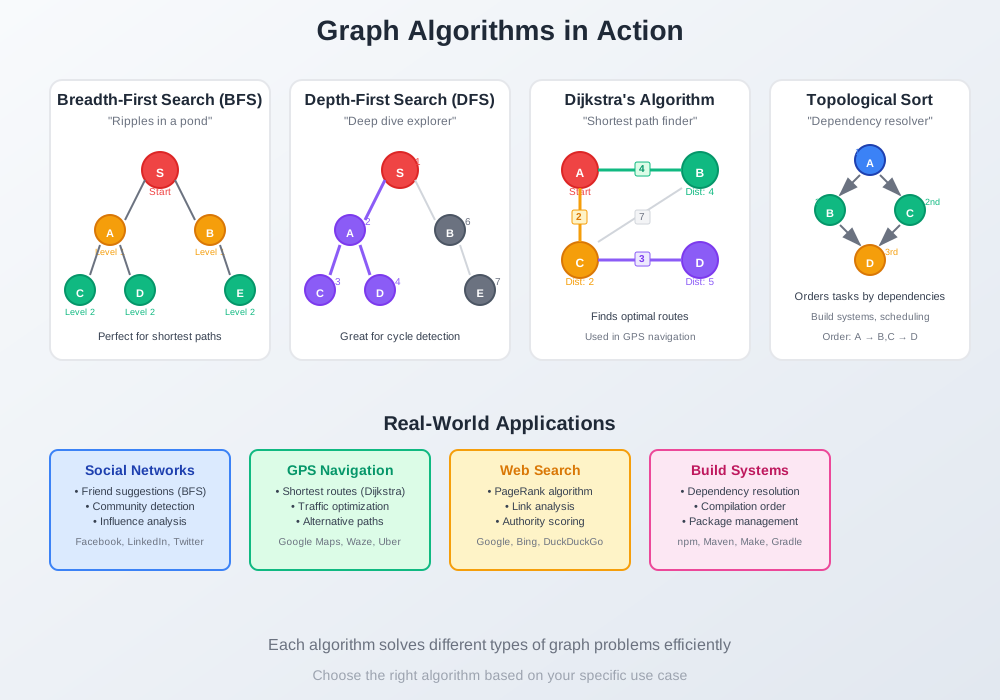
BFS explores your graph like ripples in a pond. It visits all nodes at distance 1, then all nodes at distance 2, and so on.
Think of it like this: you’re at a party and want to find someone. You first ask all your direct friends (distance 1), then ask all their friends (distance 2), and keep expanding outward.
What BFS is perfect for:
- Finding shortest paths in unweighted graphs
- “Degrees of separation” problems
- Level-by-level processing
- Finding the closest anything
Real-world magic: LinkedIn’s “People You May Know” uses BFS concepts. It looks at your direct connections, then their connections, prioritizing closer relationships.
Depth-First Search: The Deep Diver
DFS is like exploring a maze by always taking the first unexplored path you see, going as deep as possible before backtracking.
What DFS excels at:
- Detecting cycles (crucial for dependency systems)
- Finding connected components
- Generating paths through the graph
- Topological sorting (ordering tasks by dependencies)
Real-world magic: Git uses DFS concepts when traversing commit history. It follows one branch as far as possible before exploring others.
Dijkstra’s Algorithm: The Shortest Path Master
This is the algorithm behind every GPS system. It finds the shortest path from one point to everywhere else in a weighted graph.
Here’s the clever part: it always explores the closest unvisited node first, gradually building up the shortest paths like a growing bubble.
Why it’s everywhere:
- GPS navigation (shortest route)
- Network routing (fastest path for data)
- Social networks (closest connections)
- Game AI (optimal movement)
Real-world magic: When you ask Google Maps for directions, Dijkstra’s algorithm (or its variants) calculates the optimal route considering distance, traffic, and road types.
Topological Sort: The Dependency Resolver
This algorithm orders nodes so that for every edge from A to B, A comes before B in the final ordering. It’s like figuring out what order to put on your clothes—underwear before pants, socks before shoes.
Perfect for:
- Build systems (compile dependencies in the right order)
- Course scheduling (take prerequisites first)
- Task management (do dependencies before dependent tasks)
- Package managers (install dependencies first)
Real-world magic: When you run npm install, the package manager uses topological sorting to figure out what order to install packages so dependencies are available when needed.
Where Graphs Rule the World
Let me show you where graphs are secretly powering the systems you use every day.
Social Networks: The Connection Engine
Every social platform is fundamentally a graph. Users are nodes, relationships are edges. The algorithms that suggest friends, detect communities, and measure influence all rely on graph theory.
Facebook’s friend suggestions: Uses graph algorithms to analyze mutual friends, shared interests, and network proximity. If you and someone have 15 mutual friends, you probably know each other.
Twitter’s trending topics: Analyzes the graph of who retweets whom to identify influential users and spreading content.
LinkedIn’s professional network: Maps career paths, skill relationships, and professional connections to make recommendations and identify opportunities.
Web Search: The Authority Game
Google’s PageRank algorithm treats the entire web as a massive directed graph. Web pages are nodes, links are edges. The algorithm determines page importance based on the link structure.
The genius insight: pages with many high-quality incoming links are more authoritative. It’s like a popularity contest where votes from popular people count more.
How it changed everything: Before PageRank, search engines relied mainly on keyword matching. Google’s graph-based approach revolutionized web search by understanding the web’s link structure.
Transportation: The Route Optimizers
Every GPS system, delivery service, and transportation network relies on graph algorithms.
Uber’s routing: Models city streets as a weighted graph where intersections are nodes and roads are edges. Weights represent travel time, which changes based on traffic, construction, and historical data.
Amazon’s delivery optimization: Uses graph algorithms to plan delivery routes, minimize travel time, and ensure packages arrive on time. The famous “traveling salesman problem” is a graph problem.
Flight booking systems: Airlines model routes as graphs to find optimal connections, considering factors like price, duration, and layover times.
Recommendation Systems: The Taste Makers
Netflix, Spotify, and Amazon use graphs to model user preferences and item relationships.
Netflix’s recommendation engine: Creates a massive graph where users and movies are nodes. Edges represent ratings, viewing history, and similarity scores. The algorithm finds patterns in this graph to predict what you’ll like.
Spotify’s Discover Weekly: Analyzes listening patterns as a graph. If users with similar taste to you like a song you haven’t heard, it gets recommended.
Amazon’s “People who bought this also bought”: Models purchasing patterns as a graph to find related products and cross-selling opportunities.
Fraud Detection: The Pattern Hunters
Financial institutions use graphs to detect suspicious patterns and prevent fraud.
Credit card fraud detection: Models transactions as a graph to identify unusual spending patterns, detect account takeovers, and flag suspicious merchant relationships.
Money laundering detection: Traces money flows through complex networks of accounts to identify suspicious patterns that might indicate illegal activity.
Insurance fraud: Analyzes relationships between claims, people, and events to detect coordinated fraud schemes.
Making Graphs Work in Production
Here’s the stuff they don’t teach you in algorithms class—how to actually build graph systems that don’t fall over.
Choosing Your Storage Strategy
For most applications, start with adjacency lists. They’re memory efficient, work well with standard algorithms, and handle sparse graphs (which most real-world graphs are).
Use adjacency matrices only when:
- Your graph is dense (lots of connections)
- You frequently check if specific edges exist
- You’re doing mathematical operations
- Memory isn’t a constraint
Consider specialized graph databases when:
- You have complex multi-hop queries
- You need real-time graph analytics
- Your graph is too big for memory
- You’re doing serious graph analysis
The Memory Reality Check
Graphs can eat memory fast. A million-node graph with average degree 100 needs about 800MB just for the adjacency lists. Add node data, and you’re looking at gigabytes.
Strategies that work:
- Compress your node IDs (use integers, not UUIDs)
- Store edge data separately if it’s sparse
- Consider streaming algorithms for huge graphs
- Use bit vectors for boolean properties
- Implement lazy loading for graphs that don’t fit in memory
Performance Gotchas
Cache locality matters. Graph traversals jump around memory randomly, which kills cache performance. Some tricks:
- Store frequently accessed nodes together
- Use breadth-first order when possible
- Consider graph partitioning for very large graphs
Parallel processing helps. Many graph algorithms can be parallelized, but be careful about race conditions when updating shared state.
Database integration is tricky. Traditional SQL databases aren’t great at graph queries. Consider graph databases like Neo4j for complex graph operations.
The Honest Truth: When NOT to Use Graphs
Let’s be real—graphs aren’t always the answer.
Skip graphs when:
- Your data has simple linear or hierarchical structure
- You don’t need to model relationships between entities
- You’re just doing key-value lookups
- The overhead isn’t worth it for your use case
- You need guaranteed performance bounds (some graph algorithms are expensive)
Better alternatives:
- Hash tables for fast key-value lookups
- Arrays for simple sequences and mathematical operations
- Trees for hierarchical data without cross-references
- Heaps for priority-based operations
The real question: Are you modeling relationships, or just organizing data? If it’s just organization, simpler structures might be better.
Graph Databases: When to Go Professional
For serious graph work, consider specialized databases:
Neo4j: The most popular graph database. Great query language (Cypher), good tooling, handles complex queries well.
Amazon Neptune: Managed graph database with good AWS integration. Supports both property graphs and RDF.
ArangoDB: Multi-model database that handles graphs, documents, and key-value data.
When to use graph databases:
- Complex multi-hop queries (“friends of friends who like jazz”)
- Real-time graph analytics
- Large-scale graph processing
- When your SQL joins are getting ridiculous
- Social network analysis at scale
When to stick with code:
- Simple graph operations
- Small to medium graphs that fit in memory
- When you need tight integration with your application logic
- Budget constraints (graph databases can be expensive)
The Big Lessons
Here’s what I wish someone had told me when I first encountered graphs:
Start simple. Don’t try to build the perfect graph system on day one. Get something working with adjacency lists, then optimize based on your actual usage patterns.
Think about your queries first. How will you actually use this graph? The access patterns should drive your storage and algorithm choices.
Real-world graphs are usually sparse. Most nodes connect to a small fraction of other nodes. Design for sparsity unless you know otherwise.
Cycles are everywhere. Unlike trees, graphs can have cycles, and they will break naive algorithms. Always plan for cycle detection.
Memory grows fast. Graph memory usage can explode quickly. Monitor it closely and have a plan for when your graph outgrows memory.
Visualization helps. When debugging graph algorithms, being able to visualize your graph is invaluable. Invest in good visualization tools early.
The Bottom Line
Graphs aren’t just another data structure—they’re a way of thinking about problems. When you start seeing the world as nodes and edges, you’ll spot graph problems everywhere.
The next time you’re building a feature that involves relationships, dependencies, or networks, ask yourself: “Could this be modeled as a graph?” You might be surprised how often the answer is yes, and how much simpler your solution becomes.
Don’t try to force complex relationships into simple structures. Embrace the graph, and let it handle the complexity for you.
Building a system with complex relationships? Let’s talk about whether graphs are the right fit for your use case.
Comments & Discussion
Join the conversation! Share your thoughts, ask questions, or provide feedback below.