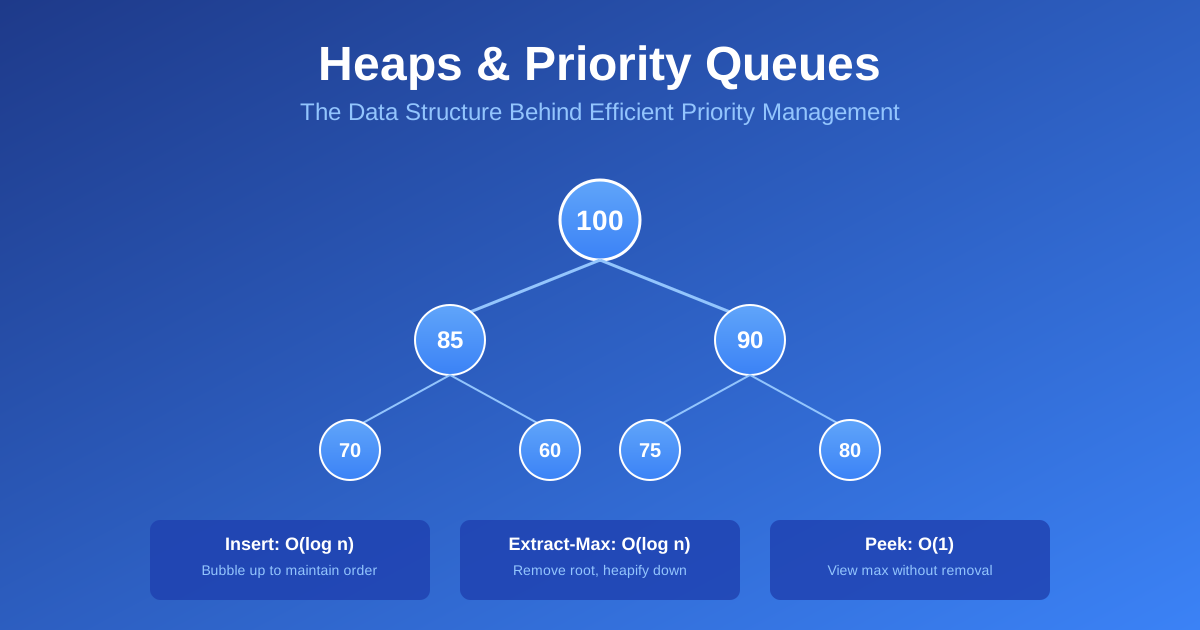
Heaps & Priority Queues: The Data Structure That Powers Everything from Task Scheduling to Dijkstra’s Algorithm
Ever wondered how your operating system decides which process to run next when you have 50 applications open? Or how Google Maps finds the fastest route among millions of possible paths in milliseconds?
The answer is priority queues, powered by a data structure called a heap. While regular queues are first-come-first-served, priority queues always give you the most important item first, regardless of arrival order.
You interact with priority queues constantly: email sorting by importance, task managers organizing by urgency, video streaming managing bandwidth—all using heaps under the hood. Once you understand heaps, you’ll see elegant solutions everywhere. Top K elements? Heap. Dijkstra’s algorithm? Heap. Real-time event processing? Heap.
The Problem: When Order Matters, But Not in the Way You Think
You’re building a hospital task scheduler. Patients arrive all day, but you can’t serve them first-come-first-served. A heart attack patient needs immediate attention, even if someone with a sprained ankle waited longer.
Or you need the top 10 products from 10 million items. Sorting everything is wasteful—you only need the top 10.
The challenge: efficiently manage a collection where some items are more important, and you constantly need the most important one.
Why Regular Data Structures Fall Short
Arrays: Finding max is O(n). With constant insertions and extractions, that’s O(n) per operation—a billion comparisons for a million operations.
Sorted arrays: Insertion is O(n) to maintain order. Great for extraction, terrible for insertion.
Binary search trees: O(log n) for max, but can become unbalanced. Overkill when you only need the maximum.
Regular queues: Perfect for fairness, useless for priority.
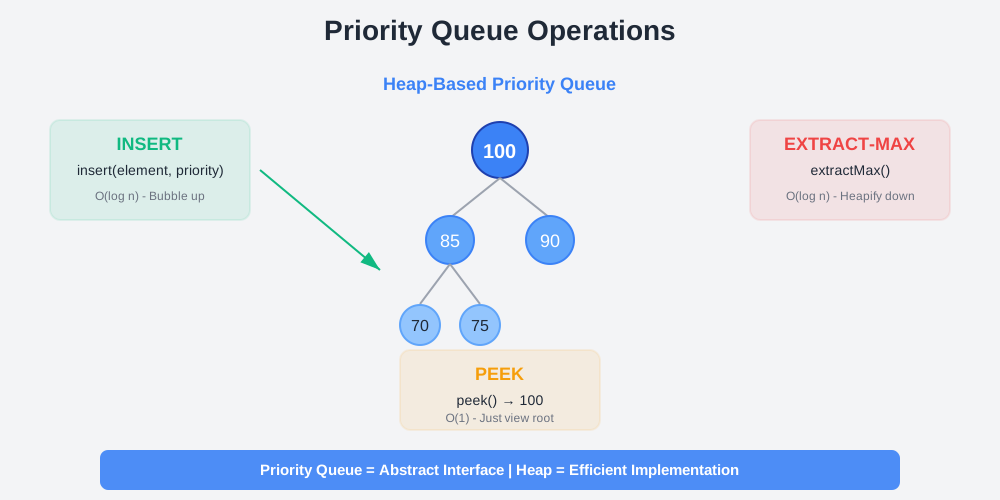
You need O(log n) insertion, O(log n) extraction, and O(1) peek. That’s exactly what heaps provide.
The Real-World Impact
A startup processing millions of events per second used a sorted array for priorities. System was crawling, dropping events everywhere.
The fix? Replace with a heap. Insertion went from O(n) to O(log n). Performance jumped from 10,000 to 500,000 events per second. Same hardware, different data structure.
Understanding Heaps: The Complete Binary Tree with a Special Property
Think of a heap like a corporate hierarchy where every manager is more important than their direct reports. In a max heap, the CEO sits at the top, and values can only decrease as you go down—never increase.
A heap is a complete binary tree satisfying the heap property:
Complete binary tree: All levels fully filled except possibly the last, which fills left to right. No gaps. This makes heaps efficient—store them in arrays without wasting space.
Heap property: In a max heap, every parent ≥ children. In a min heap, every parent ≤ children.
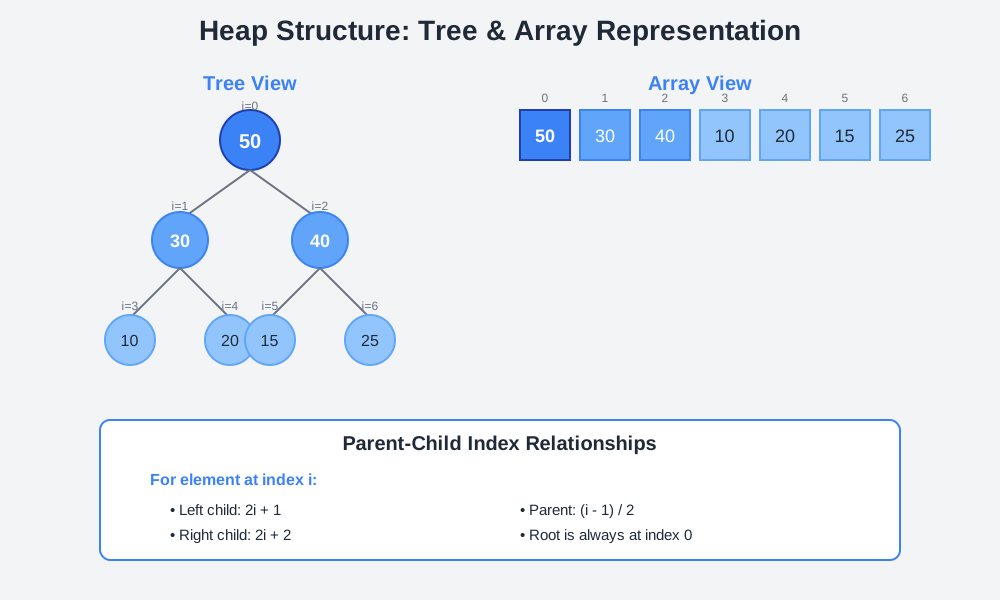
The beautiful part: no pointers needed. Store the entire heap as an array. For element at index i:
- Left child: 2i + 1
- Right child: 2i + 2
- Parent: (i - 1) / 2
This array representation means excellent cache locality—all data sits together in memory, making heaps blazing fast.
Max Heap vs Min Heap: Two Sides of the Same Coin
The only difference between max heaps and min heaps is the direction of the priority.
Max Heap: Biggest on Top
In a max heap, the largest element is always at the root. Every parent is greater than or equal to its children. This is perfect when you need quick access to the maximum element.
Use max heaps when:
- Finding the K largest elements in a dataset
- Implementing a priority queue where higher values mean higher priority
- Building a scheduling system where larger numbers indicate more urgent tasks
- Solving problems that need the maximum element repeatedly
Real-world example: A CPU scheduler using priority values where higher numbers mean higher priority. The process with priority 10 runs before the process with priority 5.
Min Heap: Smallest on Top
In a min heap, the smallest element is always at the root. Every parent is less than or equal to its children. This is ideal when you need quick access to the minimum element.
Use min heaps when:
- Finding the K smallest elements in a dataset
- Implementing Dijkstra’s shortest path algorithm (always process the closest unvisited node)
- Building a system where lower values indicate higher priority (like Unix nice values)
- Merging K sorted lists efficiently
Real-world example: Dijkstra’s algorithm for finding shortest paths. You always want to explore the node with the smallest distance first, so a min heap is perfect.
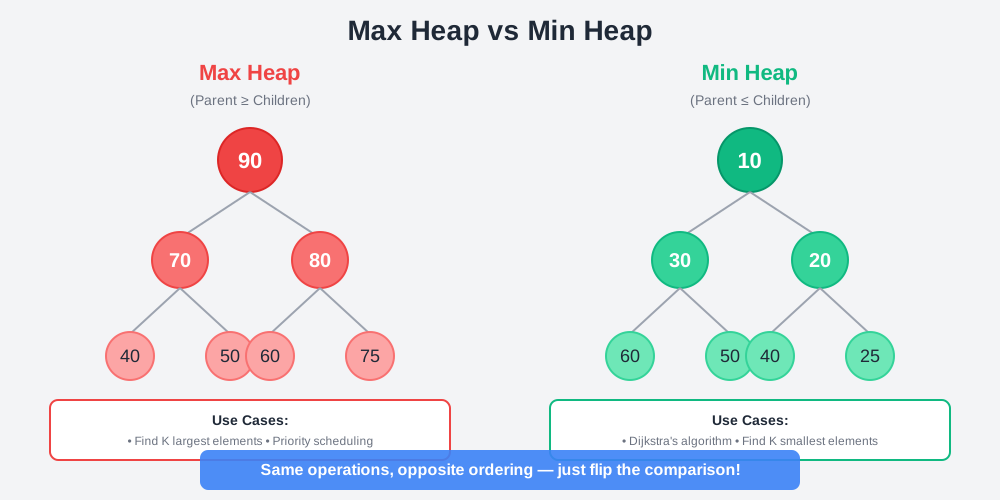
The operations are identical—just flip the comparison. If you understand one, you understand both.
Core Operations: The Magic Behind the Efficiency
Insertion: Bubble Up to Find Your Place
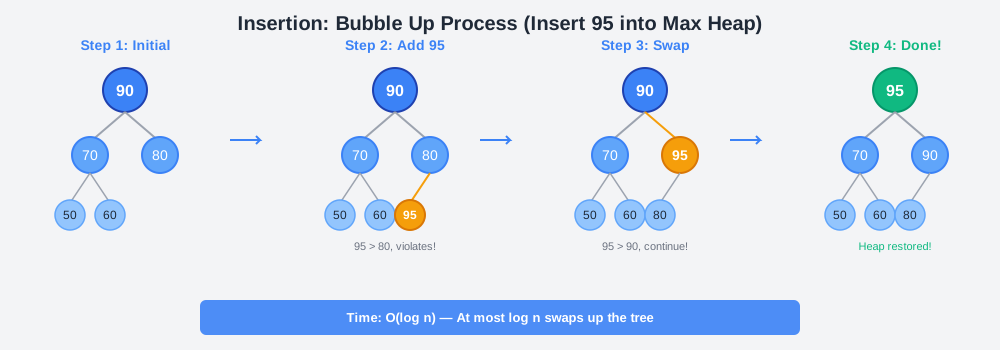
When you add a new element to a heap, you can’t just stick it anywhere—you need to maintain the heap property. Here’s how heap insertion works:
The process:
- Add the new element at the next available position (end of the array, maintaining the complete tree property)
- Compare it with its parent
- If it violates the heap property (in a max heap, if it’s larger than its parent), swap with the parent
- Repeat step 2-3 until the heap property is satisfied or you reach the root
This “bubbling up” process is also called “heapify up” or “sift up.” In the worst case, you might bubble all the way from the bottom to the top, which takes O(log n) time because the height of a complete binary tree with n elements is log n.
Why it’s fast: You’re only comparing with ancestors along one path from leaf to root. You never touch the siblings or other branches of the tree.
Extraction: Remove the Top and Reorganize
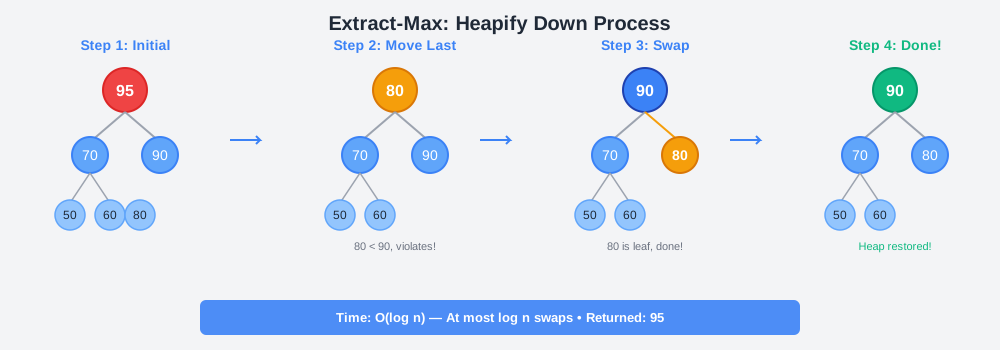
Extracting the maximum (or minimum) from a heap is where the magic really happens. You can’t just remove the root and call it a day—you need to maintain the complete tree structure and the heap property.
The process:
- Save the root element (this is what you’ll return)
- Move the last element in the heap to the root position
- Compare the new root with its children
- Swap with the larger child (in a max heap) if it violates the heap property
- Repeat steps 3-4 until the heap property is satisfied or you reach a leaf
This “sinking down” process is called “heapify down” or “sift down.” Like insertion, it’s O(log n) because you’re only following one path down the tree.
The clever part: By moving the last element to the root, you maintain the complete tree property. Then heapify down restores the heap property. Two birds, one stone.
Peek: The Free Operation
Want to see the maximum (or minimum) element without removing it? That’s trivial—just look at the root. It’s always at index 0 in your array. O(1) operation, no work required.
This is one of the key advantages of heaps over other data structures. With a sorted array, you’d need to maintain the entire sorted order. With a heap, you only maintain enough order to guarantee the maximum is at the top.
Building a Heap: The Surprising O(n) Algorithm
If you have an array of n elements and want to turn it into a heap, you might think you’d need to insert each element one by one, giving you O(n log n) time. But there’s a clever trick that does it in O(n).
The insight: Start from the bottom of the tree and heapify down. Elements at the leaves are already valid heaps (a single element is always a valid heap). Work your way up, heapifying each subtree.
Why it’s O(n): Most elements are near the bottom of the tree and don’t need to move far. Only a few elements near the top might need to sink all the way down. The math works out to O(n) total operations.
This is how you efficiently convert an unsorted array into a heap, and it’s the foundation of heapsort.
Priority Queues: The Abstract Interface
A priority queue is an abstract data type—it defines what operations you can do, not how they’re implemented. The key operations are:
- Insert: Add an element with a priority
- Extract-Max/Min: Remove and return the highest (or lowest) priority element
- Peek: Look at the highest priority element without removing it
- Change Priority: Update an element’s priority (sometimes called “decrease key” or “increase key”)
The connection to heaps: Heaps are the most common and efficient way to implement priority queues. When someone says “priority queue,” they usually mean “heap-based priority queue.”
But here’s the thing: you could implement a priority queue with other data structures. Sorted arrays, unsorted arrays, balanced BSTs—they all work. Heaps just happen to give you the best balance of insertion and extraction performance.
Priority Queue Variants
Max Priority Queue: Always gives you the element with the highest priority. Perfect for scheduling systems where higher numbers mean more urgent.
Min Priority Queue: Always gives you the element with the lowest priority. Ideal for Dijkstra’s algorithm where you want the smallest distance.
Double-Ended Priority Queue: Supports both extract-max and extract-min efficiently. Implemented with two heaps or specialized data structures like interval heaps.
Real-World Applications: Where Heaps Shine
Operating System Process Scheduling
Your OS uses priority queues to decide which process gets CPU time next. Processes have priorities (often influenced by nice values, I/O wait times, and user settings), and the scheduler always picks the highest priority ready process.
Why heaps work perfectly:
- Constant stream of new processes (insertion)
- Need to quickly find the highest priority process (extract-max)
- Priorities can change dynamically (update operation)
- Millions of scheduling decisions per second require efficiency
Linux’s Completely Fair Scheduler uses a red-black tree (a type of balanced BST), but many real-time operating systems use heap-based priority queues for their predictable O(log n) performance.
Dijkstra’s Shortest Path Algorithm
When finding the shortest path in a graph, Dijkstra’s algorithm repeatedly needs to find the unvisited node with the smallest distance. A min heap makes this efficient.
The algorithm flow:
- Start with source node at distance 0, all others at infinity
- Put all nodes in a min heap (prioritized by distance)
- Extract the minimum distance node
- Update distances to its neighbors
- Repeat until you’ve processed all nodes or found your target
Without a heap: You’d scan all unvisited nodes to find the minimum distance—O(n) per iteration, O(n²) total.
With a heap: Extract minimum is O(log n), and you do it n times—O(n log n) total. For dense graphs, this is a massive improvement.
Event-Driven Simulation Systems
Simulations (network simulators, game engines, discrete event systems) need to process events in time order. Events are scheduled for future times, and you always need to process the next chronological event.
The setup:
- Events have timestamps (priority)
- New events are constantly being scheduled (insertion)
- Always process the earliest event next (extract-min)
- Millions of events might be pending
A min heap (prioritized by timestamp) handles this perfectly. Each simulation step extracts the minimum timestamp event, processes it (which might schedule new events), and repeats.
Top K Problems
Need to find the K largest elements in a stream of millions of items? A min heap of size K is the elegant solution.
The approach:
- Create a min heap of size K
- For each new element:
- If heap isn’t full, insert it
- If heap is full and new element is larger than the minimum, remove the minimum and insert the new element
- At the end, your heap contains the K largest elements
Why it works: The smallest of your top K elements is at the root. Any element smaller than that can’t be in the top K, so you discard it. You only keep K elements in memory at once, making this incredibly space-efficient.
Real-world usage: Recommendation systems finding top N products, analytics systems finding top K users, search engines ranking top results.
Median Maintenance
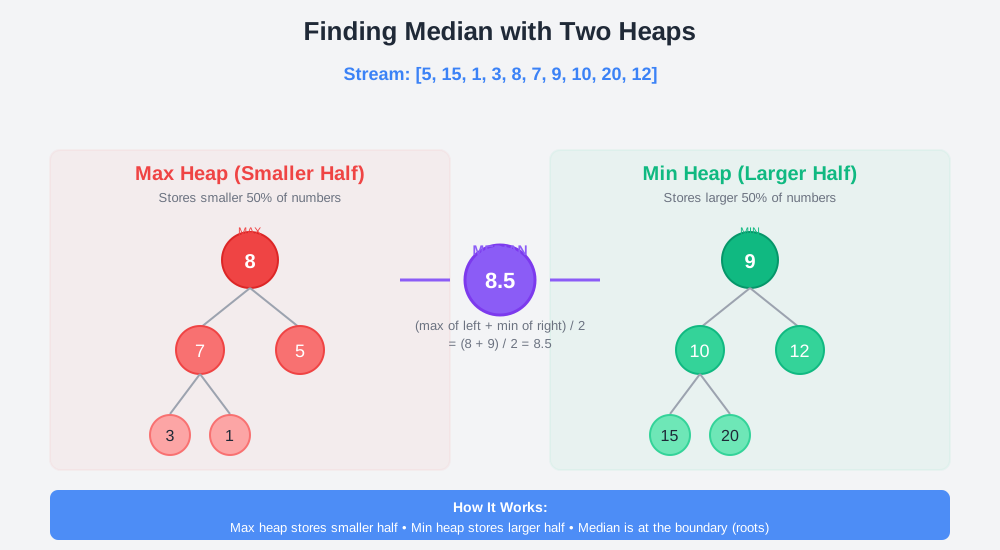
Want to find the median of a stream of numbers efficiently? Use two heaps: a max heap for the smaller half and a min heap for the larger half.
The clever trick:
- Max heap stores the smaller half of numbers (largest of the small numbers at the root)
- Min heap stores the larger half (smallest of the large numbers at the root)
- Keep the heaps balanced (sizes differ by at most 1)
- The median is either the root of the larger heap, or the average of both roots
Operations:
- Insert: O(log n) - add to appropriate heap and rebalance if needed
- Get median: O(1) - just look at the roots
This pattern is used in streaming analytics, real-time statistics, and financial systems tracking moving medians.
Heapsort: The Elegant Sorting Algorithm
Heapsort is a comparison-based sorting algorithm that uses a heap. It’s not as fast as quicksort in practice, but it has guaranteed O(n log n) worst-case performance and sorts in-place.
The algorithm:
- Build a max heap from the input array - O(n)
- Repeatedly extract the maximum and place it at the end of the array - O(n log n)
- The array is now sorted in ascending order
Why it works: Each extraction gives you the next largest element. By placing extracted elements at the end of the array (in the space freed up by the shrinking heap), you sort in-place.
Pros:
- ✓ Guaranteed O(n log n) worst case (unlike quicksort’s O(n²))
- ✓ In-place sorting (O(1) extra space)
- ✓ No worst-case input that kills performance
Cons:
- ✗ Slower than quicksort in practice (poor cache locality)
- ✗ Not stable (equal elements might change relative order)
- ✗ More complex to implement than simpler sorts
When to use heapsort: When you need guaranteed O(n log n) performance and can’t afford quicksort’s worst case, or when memory is extremely limited and you can’t use merge sort’s O(n) extra space.
Implementation Considerations: Making It Production-Ready
Array-Based vs Pointer-Based Implementation
Array-based (most common):
- Store heap as an array with implicit parent-child relationships
- Excellent cache locality—all data is contiguous
- Simple index arithmetic for navigation
- Fixed maximum size (unless you use dynamic arrays)
Pointer-based (rare):
- Explicit node objects with left/right child pointers
- Dynamic sizing without reallocation
- More memory overhead (pointers take space)
- Worse cache performance (nodes scattered in memory)
The verdict: Use array-based unless you have a very specific reason not to. The cache performance difference is significant in practice.
Dynamic Resizing
When your heap grows beyond the array capacity, you need to resize. The standard approach:
- Allocate a new array (typically double the size)
- Copy all elements to the new array
- Free the old array
This gives you amortized O(1) insertion cost, just like dynamic arrays. The occasional expensive resize is spread across many cheap insertions.
Shrinking: Some implementations also shrink the array when the heap becomes too empty (say, less than 25% full). This prevents wasting memory but adds complexity.
Handling Duplicate Priorities
What happens when two elements have the same priority? The heap property doesn’t specify an order for equal elements.
Options:
- Don’t care: Let equal elements be in arbitrary order (simplest, often fine)
- Secondary key: Use a tiebreaker (like insertion order or a secondary priority)
- Stable heap: Maintain insertion order for equal priorities (complex, rarely needed)
For most applications, arbitrary order for equal priorities is perfectly acceptable.
Custom Comparison Functions
Real-world priority queues often need custom priority logic. Instead of comparing raw values, you might compare based on:
- A specific field of an object
- A computed priority score
- Multiple criteria with tiebreakers
The solution: Pass a comparison function or comparator object to your heap implementation. This is how C++’s std::priority_queue, Python’s heapq, and Java’s PriorityQueue work.
Performance Characteristics: The Numbers Game
Here’s the honest breakdown of heap performance:
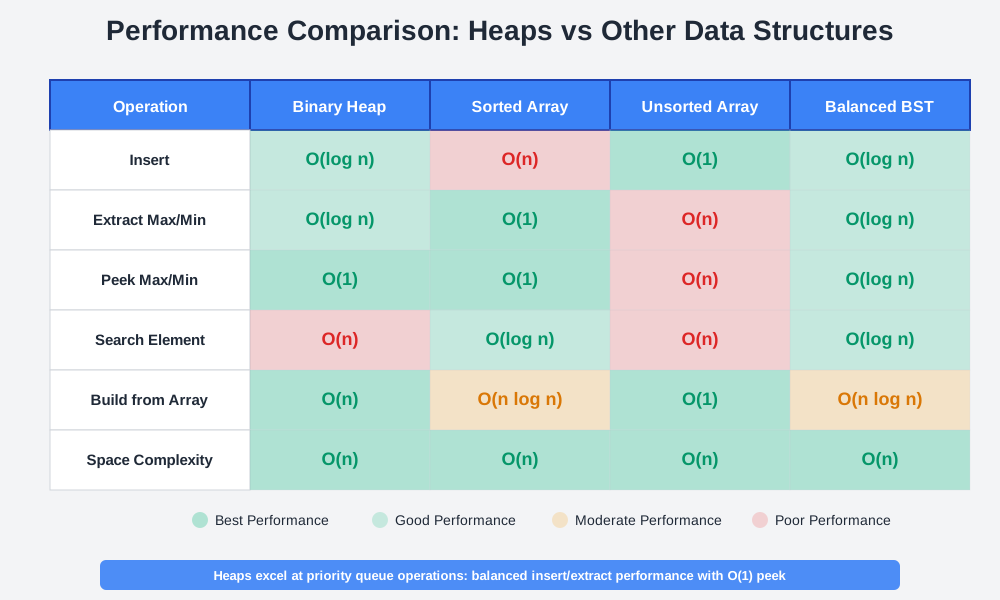
Insertion: O(log n) - Bubble up at most log n levels Extract-Max/Min: O(log n) - Heapify down at most log n levels Peek: O(1) - Just look at the root Build Heap: O(n) - Surprisingly linear, not O(n log n) Search: O(n) - No better than linear search (heaps aren’t designed for searching) Delete arbitrary element: O(n) to find + O(log n) to remove = O(n) Change priority: O(n) to find + O(log n) to adjust = O(n)
Space complexity: O(n) for storing n elements, O(1) extra space for operations
Comparison with Other Data Structures
Heaps vs Sorted Arrays:
- Heaps: O(log n) insert, O(log n) extract-max, O(1) peek
- Sorted arrays: O(n) insert, O(1) extract-max, O(1) peek
- Winner: Heaps for frequent insertions, sorted arrays for rare insertions
Heaps vs Balanced BSTs:
- Heaps: O(log n) insert, O(log n) extract-max, O(1) peek, simpler implementation
- BSTs: O(log n) insert, O(log n) extract-max, O(log n) peek, supports range queries
- Winner: Heaps for priority queue operations, BSTs for more complex queries
Heaps vs Unsorted Arrays:
- Heaps: O(log n) insert, O(log n) extract-max
- Unsorted arrays: O(1) insert, O(n) extract-max
- Winner: Heaps unless you insert way more than you extract
Advanced Heap Variants
Binary Heap: The Standard
This is what we’ve been discussing—the classic heap with two children per node. Simple, efficient, and the default choice for most applications.
D-ary Heap: More Children, Different Trade-offs
Instead of two children per node, use d children. Common choices are d=3 (ternary heap) or d=4 (quaternary heap).
Trade-offs:
- Shallower tree (height is log_d(n) instead of log_2(n))
- Faster extract operations (fewer levels to traverse)
- Slower insert operations (more children to compare when heapifying down)
- Better cache performance for large heaps (more data per cache line)
When to use: When you extract much more often than you insert, or when working with very large heaps where cache performance matters.
Fibonacci Heap: The Theoretical Champion
Fibonacci heaps have amazing theoretical performance:
- Insert: O(1) amortized
- Extract-min: O(log n) amortized
- Decrease key: O(1) amortized
The catch: Complex implementation, high constant factors, poor cache performance. In practice, binary heaps often outperform Fibonacci heaps despite worse theoretical complexity.
Where they shine: Dijkstra’s algorithm and Prim’s minimum spanning tree algorithm, where decrease-key operations are frequent. But even there, binary heaps with lazy deletion often work better in practice.
Binomial Heap: The Mergeable Heap
Binomial heaps support efficient merging of two heaps in O(log n) time. Binary heaps need O(n) to merge.
Structure: A collection of binomial trees with specific properties.
When to use: When you frequently need to merge priority queues. Rare in practice, but elegant in theory.
Pairing Heap: The Practical Alternative
Pairing heaps are simpler than Fibonacci heaps but have similar performance in practice. They’re used in some graph algorithm implementations.
Performance: Insert and decrease-key are O(1) amortized, extract-min is O(log n) amortized.
The appeal: Simpler to implement than Fibonacci heaps, better constant factors, still supports efficient decrease-key.
Common Pitfalls and How to Avoid Them
Pitfall 1: Forgetting the Complete Tree Property
The mistake: Adding nodes in the wrong order, creating gaps in the tree.
The fix: Always add new elements at the next available position (end of array). Never skip positions.
Red flag: Your heap array has gaps or null values in the middle.
Pitfall 2: Incorrect Parent/Child Index Calculations
The mistake: Off-by-one errors in index arithmetic, especially when using 1-based indexing.
The fix: Stick to 0-based indexing with these formulas:
- Left child: 2i + 1
- Right child: 2i + 2
- Parent: (i - 1) / 2 (integer division)
Red flag: Heap operations crash with index out of bounds errors.
Pitfall 3: Not Handling Edge Cases
The mistake: Forgetting to check for empty heap, single-element heap, or full heap (in fixed-size implementations).
The fix: Always check heap size before operations. Handle empty heap gracefully (throw exception or return null/error).
Red flag: Crashes when extracting from empty heap or inserting into full heap.
Pitfall 4: Modifying Elements Without Reheapifying
The mistake: Changing an element’s priority directly in the array without restoring the heap property.
The fix: After modifying an element, call heapify-up or heapify-down as appropriate. Or use a proper “change priority” operation.
Red flag: Heap property violations, incorrect extract-max results.
Pitfall 5: Using Heaps for the Wrong Problem
The mistake: Using a heap when you need to search for arbitrary elements or maintain sorted order.
The fix: Heaps are for priority queue operations. If you need search or sorted iteration, use a different data structure.
Red flag: O(n) search operations dominating your performance.
Interview Patterns: Recognizing Heap Problems
Pattern 1: Top K Elements
Problem signature: Find the K largest/smallest elements in a collection.
Heap approach: Use a min heap of size K for K largest (or max heap for K smallest). Maintain only K elements at a time.
Why it works: The smallest of your top K elements is at the root. Anything smaller can’t be in the top K.
Example problems: Top K frequent elements, K closest points to origin, K largest numbers in a stream.
Pattern 2: Merge K Sorted Lists/Arrays
Problem signature: Combine multiple sorted sequences into one sorted sequence.
Heap approach: Use a min heap containing the current smallest element from each list. Extract minimum, add the next element from that list.
Why it works: The global minimum must be the minimum of the current elements from each list. The heap finds this efficiently.
Example problems: Merge K sorted lists, smallest range covering elements from K lists.
Pattern 3: Median Maintenance
Problem signature: Find the median of a stream of numbers.
Heap approach: Two heaps—max heap for smaller half, min heap for larger half. Keep them balanced.
Why it works: The median is always at the boundary between the two halves, accessible at the roots.
Example problems: Find median from data stream, sliding window median.
Pattern 4: Scheduling and Intervals
Problem signature: Process tasks/events based on time or priority.
Heap approach: Use a min heap ordered by start time, end time, or deadline.
Why it works: Always process the most urgent/earliest task next.
Example problems: Meeting rooms, task scheduler, minimum number of platforms needed.
Pattern 5: Greedy Algorithms with Priority
Problem signature: Make locally optimal choices based on some priority.
Heap approach: Use a heap to always select the best next choice according to your greedy criterion.
Why it works: Heaps efficiently maintain the best option as you make choices and add new options.
Example problems: Huffman coding, connect ropes with minimum cost, minimize deviation in array.
Debugging Heap Issues
When heaps misbehave, here’s your systematic debugging approach:
Step 1: Verify the Heap Property
The test: For every node, check that it satisfies the heap property relative to its children.
How to check: Iterate through the array, for each index i, verify:
- Max heap: array[i] >= array[2i+1] and array[i] >= array[2i+2]
- Min heap: array[i] <= array[2i+1] and array[i] <= array[2i+2]
Red flags: Any violation means your heap is corrupted.
Step 2: Verify the Complete Tree Property
The test: Check that there are no gaps in your array representation.
How to check: Your heap should use array indices 0 through size-1 continuously, with no gaps.
Red flags: Null values or gaps in the middle of the array.
Step 3: Trace Operations Step-by-Step
The test: Manually trace insertion and extraction operations.
How to trace:
- Draw the tree structure before the operation
- Show each swap during heapify-up or heapify-down
- Verify the heap property after each swap
- Draw the final tree structure
Red flags: Heap property violations at any step.
Step 4: Check Index Arithmetic
The test: Verify parent/child index calculations.
How to check: For several nodes, manually calculate parent and child indices and verify they’re correct.
Red flags: Accessing wrong children or parents, index out of bounds errors.
Step 5: Validate Edge Cases
The test: Test with empty heap, single element, two elements, and full heap.
How to test: Run all operations on these edge cases and verify correct behavior.
Red flags: Crashes or incorrect results on edge cases.
Language-Specific Implementations
Python: heapq Module
Python’s heapq module provides a min heap implementation using regular lists.
Key characteristics:
- Min heap only (negate values for max heap behavior)
- In-place operations on lists
- No object-oriented interface (just functions)
- Efficient and well-tested
Common operations:
heapq.heappush(heap, item)- Insertheapq.heappop(heap)- Extract minheapq.heapify(list)- Build heap from list in O(n)heapq.nlargest(k, iterable)- Top K largestheapq.nsmallest(k, iterable)- Top K smallest
For max heap: Use negative values or wrap items in a class with reversed comparison.
Java: PriorityQueue Class
Java’s PriorityQueue is a min heap by default, with support for custom comparators.
Key characteristics:
- Generic type support
- Custom comparator for different orderings
- Not thread-safe (use
PriorityBlockingQueuefor concurrent access) - Backed by array with automatic resizing
Common operations:
add(element)oroffer(element)- Insertpoll()- Extract and remove minpeek()- View min without removingremove(element)- Remove specific element (O(n))
For max heap: Provide Collections.reverseOrder() as comparator.
C++: std::priority_queue
C++’s std::priority_queue is a max heap by default (opposite of most languages).
Key characteristics:
- Template-based with type safety
- Max heap by default
- Backed by vector (dynamic array)
- Part of STL with consistent interface
Common operations:
push(element)- Insertpop()- Remove max (doesn’t return it)top()- View max without removingempty()- Check if emptysize()- Get number of elements
For min heap: Use std::priority_queue<int, std::vector<int>, std::greater<int>>.
JavaScript: No Built-in Heap
JavaScript doesn’t have a built-in heap implementation. You’ll need to implement your own or use a library.
Popular libraries:
heap-js- Full-featured heap implementation@datastructures-js/priority-queue- Priority queue with heap backing
DIY approach: Implement a simple heap class with array backing. It’s a good learning exercise and gives you full control.
The Big Lessons
Heaps are the unsung heroes of efficient algorithms. They’re not as famous as hash tables or as fundamental as arrays, but they solve a specific class of problems better than anything else.
The key insight? You don’t always need full sorted order. Sometimes you just need the maximum (or minimum) element, and you need it fast. Heaps give you that with O(log n) operations and O(1) peek, which is the sweet spot for priority queue operations.
When you see a problem that involves “top K,” “largest,” “smallest,” “priority,” or “scheduling,” think heaps. When you’re implementing Dijkstra’s algorithm or any greedy algorithm that needs to pick the best option repeatedly, think heaps.
The beauty of heaps is in their simplicity. The array representation, the simple parent-child relationships, the elegant heapify operations—it all fits together into a data structure that’s both theoretically efficient and practically fast.
The Bottom Line
Heaps aren’t just an academic concept you memorize for interviews. They’re a practical tool that makes complex problems tractable. From operating system schedulers to pathfinding algorithms to real-time analytics, heaps are everywhere in production systems.
Start with the basics: understand the heap property, practice insertion and extraction by hand, implement a simple heap from scratch. Then look for heap patterns in the problems you solve. Once you start seeing them, you’ll wonder how you ever lived without them.
The next time you need to find the top K elements, maintain a median, or implement any kind of priority-based system, reach for a heap. Your code will be faster, simpler, and more elegant.
Ready to master more data structures and algorithms? Explore the complete DSA guide or let’s discuss your specific learning goals.
Comments & Discussion
Join the conversation! Share your thoughts, ask questions, or provide feedback below.