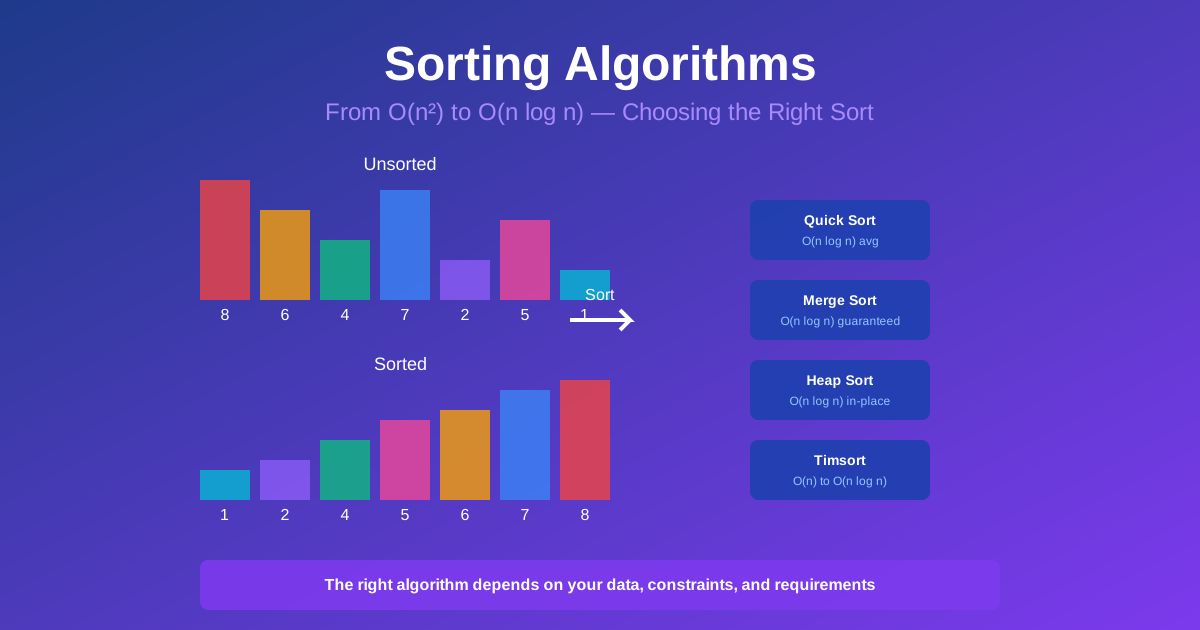
Sorting Algorithms: The Complete Guide to Choosing the Right Sort for Your Data
Ever wondered why your database query returns results in milliseconds even with millions of records? Or how Netflix sorts thousands of movies by rating, release date, and relevance simultaneously? Or why Python’s sort is so fast it’s almost magical?
The answer is sorting algorithms—and not just any sorting algorithm, but the right one for the job. While beginners learn bubble sort, production systems use sophisticated algorithms like Timsort (Python) and introsort (C++). The difference? Orders of magnitude in performance.
Here’s what most developers don’t realize: choosing the wrong sorting algorithm can turn a 100ms operation into a 10-second nightmare. But pick the right one, and you’ll handle millions of records without breaking a sweat. Understanding sorting isn’t just about interviews—it’s about writing code that scales.
The Problem: Why Sorting Matters More Than You Think
You’re building a social media feed that needs to display posts by relevance, recency, and engagement. You have 100,000 posts to sort every time a user refreshes. Use the wrong algorithm, and your users wait 5 seconds. Use the right one, and it’s instant.
Or you’re processing financial transactions that must be sorted by timestamp for audit compliance. The data is mostly sorted already (new transactions append to the end), but occasionally you get out-of-order entries. Do you re-sort everything from scratch?
The challenge: different data patterns need different sorting strategies. Random data, nearly-sorted data, data with duplicates, small datasets, huge datasets—each scenario has an optimal algorithm.
Why Simple Sorts Aren’t Always Wrong
The surprising truth: Sometimes bubble sort beats quicksort. When your array has 10 elements, the overhead of quicksort’s recursion costs more than bubble sort’s simplicity. When data is already sorted, insertion sort runs in O(n)—faster than any O(n log n) algorithm.
The real question: Not “which algorithm is fastest?” but “which algorithm is fastest for my specific data and constraints?”
The Real-World Impact
A fintech startup was sorting transaction records using quicksort. Worked great in testing with random data. In production? Disaster. Their transactions came in mostly sorted order, triggering quicksort’s O(n²) worst case. System ground to a halt during peak hours.
The fix? Switch to Timsort, which exploits existing order. Same data, 50x faster. Understanding sorting algorithms isn’t academic—it’s survival.
Understanding Sorting: The Big Picture
Sorting means arranging elements in a specific order—usually ascending or descending. Sounds simple, but the way you do it determines whether your code runs in milliseconds or minutes.
Think of sorting like organizing a deck of cards. You could compare every card with every other card (bubble sort), or you could split the deck in half repeatedly and merge sorted halves (merge sort), or you could pick a pivot and partition around it (quicksort). Same goal, wildly different approaches.
The key metrics:
- Time complexity: How operations scale with input size
- Space complexity: Extra memory needed
- Stability: Do equal elements maintain their relative order?
- Adaptivity: Does it exploit existing order in the data?
- In-place: Does it sort without extra memory?
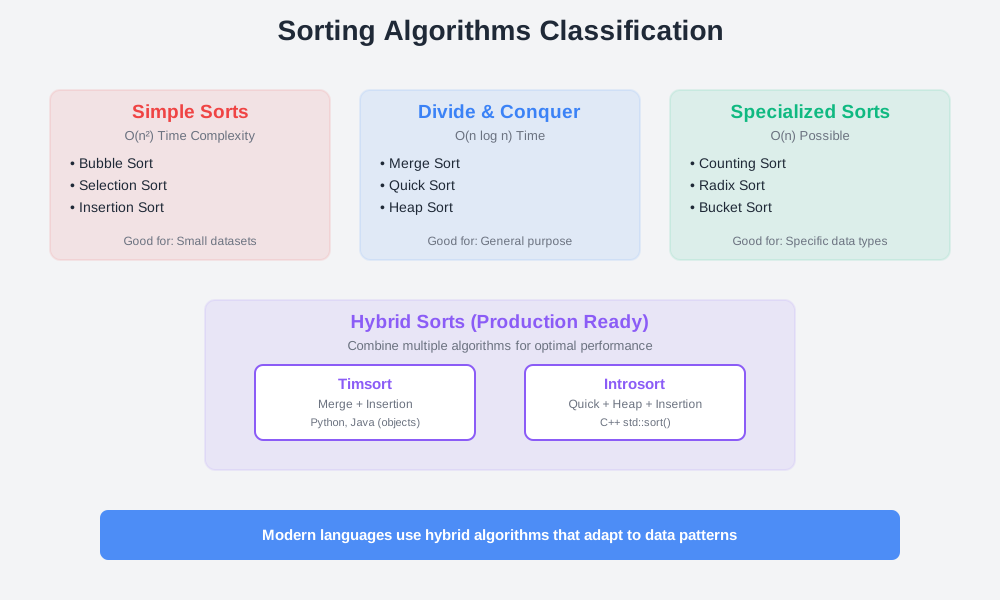
The Simple Sorts: When Simplicity Wins
Bubble Sort: The Teaching Tool
Bubble sort repeatedly steps through the list, compares adjacent elements, and swaps them if they’re in the wrong order. Like bubbles rising to the surface, larger elements “bubble up” to the end.
How it works: Compare pairs from left to right. After each pass, the largest unsorted element reaches its final position. Repeat until no swaps occur.
Time complexity: O(n²) average and worst case, O(n) best case (already sorted) Space complexity: O(1) Stable: Yes When to use: Never in production. Great for teaching, terrible for real data.
Why it’s slow: Makes n² comparisons even when data is nearly sorted. Every element potentially moves one position per pass.
Selection Sort: Slightly Better, Still Bad
Selection sort divides the array into sorted and unsorted regions. It repeatedly finds the minimum element from the unsorted region and moves it to the sorted region.
How it works: Find the minimum in the unsorted portion, swap it with the first unsorted element, expand the sorted region. Repeat.
Time complexity: O(n²) in all cases Space complexity: O(1) Stable: No (can be made stable with extra space) When to use: When memory writes are expensive (flash memory, EEPROM)
The one advantage: Minimizes the number of swaps. If writing to memory is costly, selection sort makes only O(n) swaps versus bubble sort’s O(n²).
Insertion Sort: The Surprisingly Useful One
Insertion sort builds the sorted array one element at a time by inserting each element into its correct position in the already-sorted portion.
How it works: Start with the second element. Compare it with elements in the sorted portion (to its left) and insert it in the correct position. Repeat for all elements.
Time complexity: O(n²) worst case, O(n) best case (sorted data) Space complexity: O(1) Stable: Yes Adaptive: Yes—fast on nearly sorted data
When to use:
- Small datasets (< 50 elements)
- Nearly sorted data
- As the base case in hybrid algorithms (Timsort, introsort)
- Online sorting (elements arrive one at a time)
Why it’s actually useful: On small or nearly-sorted arrays, insertion sort beats everything else. Its simplicity means low overhead, and it’s adaptive—it runs in O(n) when data is already sorted.
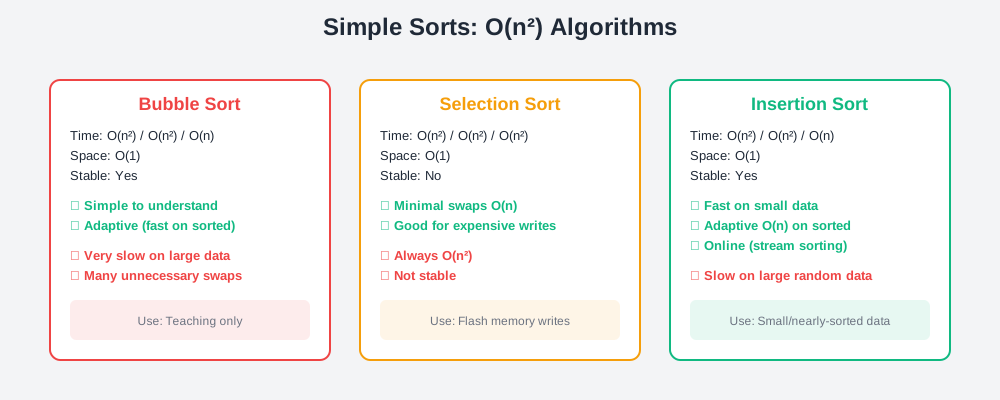
The Divide-and-Conquer Sorts: Breaking Down the Problem
Merge Sort: The Reliable Workhorse
Merge sort divides the array in half, recursively sorts each half, then merges the sorted halves. It’s the “divide and conquer” poster child.
How it works: Split array into two halves. Recursively sort each half. Merge the two sorted halves by comparing elements and building a sorted result.
Time complexity: O(n log n) in all cases—guaranteed Space complexity: O(n) for the merge operation Stable: Yes When to use: When you need guaranteed O(n log n) performance and stability
The merge operation: Two sorted arrays become one sorted array by repeatedly taking the smaller of the two front elements. This is where the magic happens—merging is O(n) and maintains stability.
Pros:
- ✓ Guaranteed O(n log n)—no worst case surprises
- ✓ Stable—maintains relative order of equal elements
- ✓ Predictable performance
- ✓ Works well with linked lists (no random access needed)
- ✓ Parallelizable—each half can be sorted independently
Cons:
- ✗ Requires O(n) extra space
- ✗ Not adaptive—doesn’t benefit from existing order
- ✗ Slower than quicksort on average due to extra copying
Real-world usage: Java’s Arrays.sort() for objects (needs stability), external sorting (sorting data larger than memory), parallel sorting algorithms.
Quick Sort: The Speed Demon
Quicksort picks a “pivot” element, partitions the array so elements smaller than the pivot are on the left and larger ones on the right, then recursively sorts the partitions.
How it works: Choose a pivot. Rearrange array so all elements less than pivot come before it, all greater come after. Recursively apply to left and right partitions.
Time complexity: O(n log n) average, O(n²) worst case Space complexity: O(log n) for recursion stack Stable: No When to use: When average-case performance matters more than worst-case guarantees
The partition operation: This is quicksort’s heart. Rearrange elements around the pivot in O(n) time. After partitioning, the pivot is in its final sorted position.
Pros:
- ✓ Fastest average-case performance
- ✓ In-place sorting (O(log n) stack space only)
- ✓ Cache-friendly (good locality of reference)
- ✓ Small constant factors
Cons:
- ✗ O(n²) worst case (already sorted data with bad pivot choice)
- ✗ Not stable
- ✗ Vulnerable to adversarial input
- ✗ Recursive (stack overflow risk on deep recursion)
Pivot selection strategies:
- First/last element: Simple but vulnerable to worst case
- Random element: Avoids worst case on sorted data
- Median-of-three: Pick median of first, middle, last elements
- Median-of-medians: Guaranteed good pivot but expensive
Real-world usage: C++ std::sort() (as part of introsort), general-purpose sorting when stability isn’t needed, in-memory sorting of primitive types.

The Efficient Sorts: Specialized for Specific Data
Heap Sort: The Guaranteed In-Place Sort
Heapsort builds a max heap from the data, then repeatedly extracts the maximum element and places it at the end of the array.
How it works: Build a max heap from the array. Swap the root (maximum) with the last element, reduce heap size, and heapify. Repeat until heap is empty.
Time complexity: O(n log n) guaranteed Space complexity: O(1)—truly in-place Stable: No When to use: When you need O(n log n) guarantee with O(1) space
Pros:
- ✓ Guaranteed O(n log n)
- ✓ In-place (O(1) extra space)
- ✓ No worst-case surprises
Cons:
- ✗ Not stable
- ✗ Poor cache locality (heap operations jump around memory)
- ✗ Slower than quicksort in practice
- ✗ Not adaptive
Real-world usage: Embedded systems with limited memory, when you need guaranteed performance without extra space.
Counting Sort: The Linear Time Sort
Counting sort counts the occurrences of each distinct element, then uses arithmetic to determine positions. It’s not comparison-based—it can break the O(n log n) barrier.
How it works: Count occurrences of each value. Calculate cumulative counts to determine positions. Place elements in output array based on counts.
Time complexity: O(n + k) where k is the range of input Space complexity: O(k) Stable: Yes When to use: When range of values (k) is not significantly larger than n
The catch: Only works with integers or things that can be mapped to integers. If k » n, it’s impractical.
Example: Sorting 1 million numbers in range 0-1000. Counting sort is O(1,001,000) versus O(1,000,000 log 1,000,000) ≈ O(20,000,000) for comparison sorts.
Real-world usage: Sorting by age, grades, small integer keys, as a subroutine in radix sort.
Radix Sort: Sorting by Digits
Radix sort processes integers digit by digit, using a stable sort (usually counting sort) for each digit position.
How it works: Sort by least significant digit first, then next digit, and so on. Each digit sort must be stable to maintain previous ordering.
Time complexity: O(d × (n + k)) where d is number of digits, k is digit range Space complexity: O(n + k) Stable: Yes When to use: Sorting integers, strings, or fixed-length keys
LSD vs MSD:
- LSD (Least Significant Digit): Start from rightmost digit, simpler
- MSD (Most Significant Digit): Start from leftmost digit, can short-circuit
Real-world usage: Sorting strings, IP addresses, dates, any fixed-length keys.
Bucket Sort: Divide and Conquer by Range
Bucket sort distributes elements into buckets, sorts each bucket individually, then concatenates buckets.
How it works: Create buckets for value ranges. Distribute elements into buckets. Sort each bucket (often with insertion sort). Concatenate buckets.
Time complexity: O(n + k) average case, O(n²) worst case Space complexity: O(n + k) Stable: Depends on bucket sorting algorithm When to use: When input is uniformly distributed over a range
The key: If elements distribute evenly across buckets, each bucket is small and sorts quickly. If distribution is skewed, performance degrades.
Real-world usage: Sorting floating-point numbers in known range, external sorting, histogram generation.
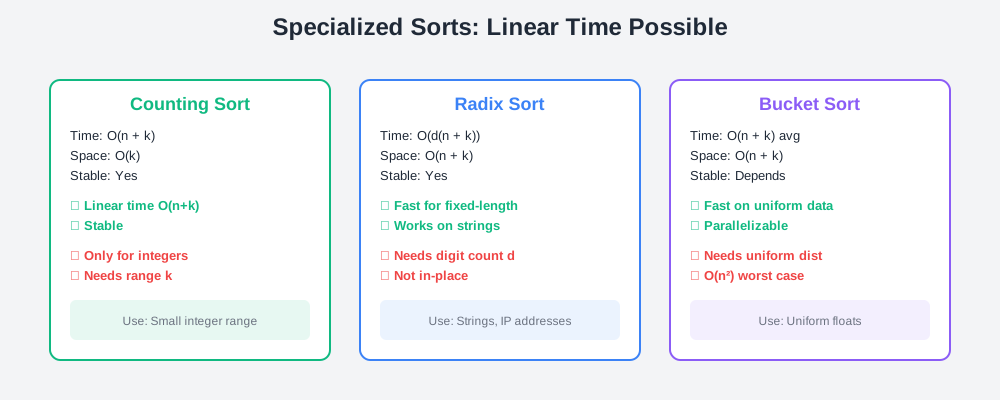
The Hybrid Sorts: Best of Both Worlds
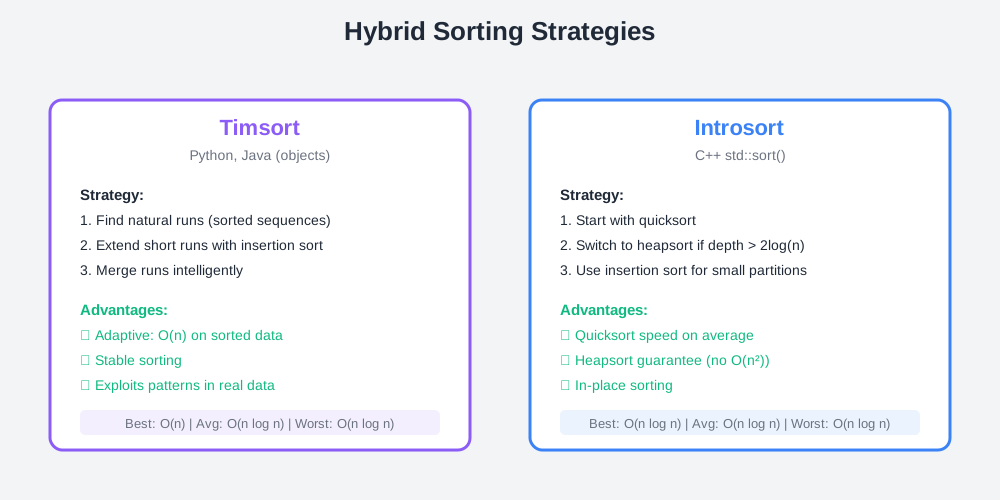
Timsort: Python’s Secret Weapon
Timsort is a hybrid of merge sort and insertion sort, designed to perform well on real-world data. It identifies “runs” of already-sorted data and merges them efficiently.
How it works: Find natural runs (already sorted sequences). Extend short runs to minimum length using insertion sort. Merge runs using a modified merge sort.
Time complexity: O(n log n) worst case, O(n) best case Space complexity: O(n) Stable: Yes Adaptive: Yes—exploits existing order
Why it’s brilliant:
- Detects and exploits patterns in real data
- Uses insertion sort for small runs (< 64 elements)
- Merges runs in a clever order to minimize comparisons
- Stable and adaptive
Real-world usage: Python’s sorted() and list.sort(), Java’s Arrays.sort() for objects, Android’s sorting.
Introsort: C++’s Hybrid Approach
Introsort starts with quicksort, switches to heapsort if recursion depth exceeds a limit (avoiding O(n²) worst case), and uses insertion sort for small partitions.
How it works: Begin with quicksort. If recursion depth exceeds 2 × log n, switch to heapsort. For partitions smaller than 16 elements, use insertion sort.
Time complexity: O(n log n) guaranteed Space complexity: O(log n) Stable: No When to use: General-purpose sorting without stability requirement
Why it’s clever:
- Quicksort’s speed on average
- Heapsort’s guarantee against worst case
- Insertion sort’s efficiency on small data
Real-world usage: C++ std::sort(), Rust’s unstable sort.
Choosing the Right Sort: A Decision Framework
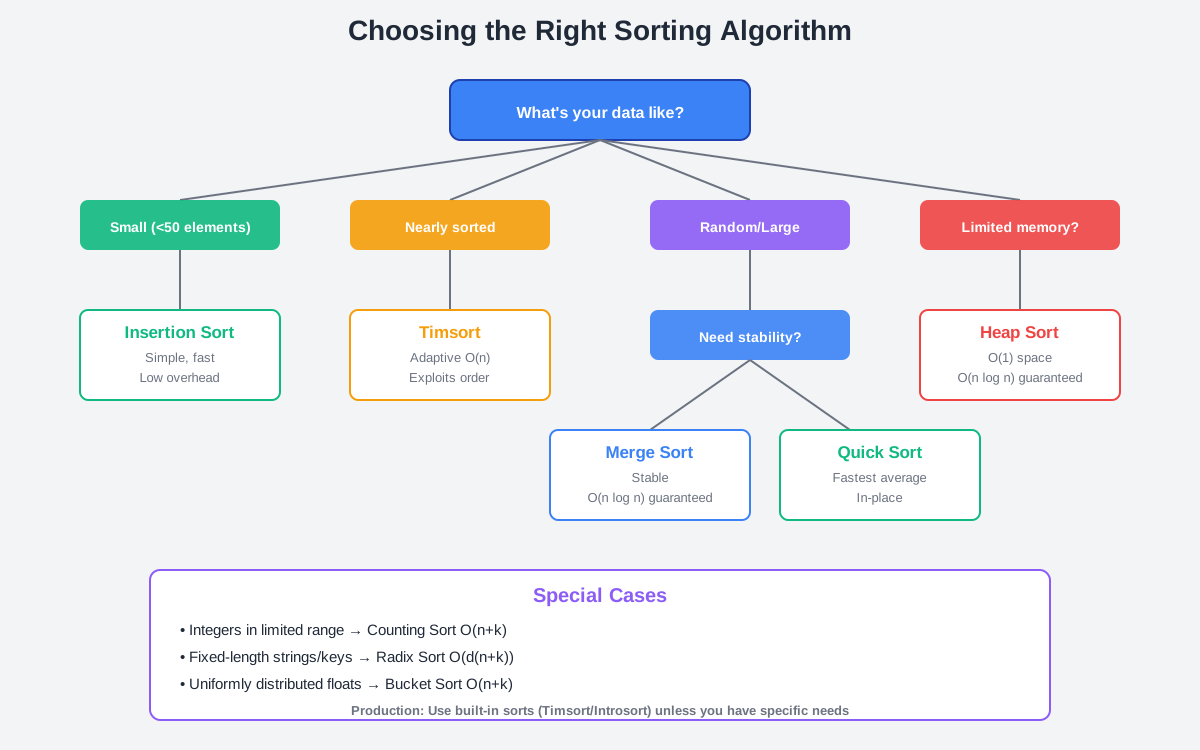
Here’s how to pick the right algorithm for your situation:
For small arrays (< 50 elements): → Insertion sort. Simple, fast, low overhead.
For nearly sorted data: → Insertion sort or Timsort. Both are adaptive and run in O(n) on sorted data.
For guaranteed O(n log n) with stability: → Merge sort. Reliable, stable, predictable.
For guaranteed O(n log n) in-place: → Heapsort. No extra space, no worst case.
For best average performance: → Quicksort (with good pivot selection) or introsort.
For integers in limited range: → Counting sort or radix sort. Linear time when applicable.
For uniformly distributed data: → Bucket sort. Can approach O(n) with good distribution.
For production code: → Use your language’s built-in sort (Timsort in Python, introsort in C++). They’re highly optimized and handle edge cases.
For linked lists: → Merge sort. Doesn’t need random access, works naturally with linked structures.
For external sorting (data larger than memory): → External merge sort. Minimizes disk I/O.
Performance Comparison: The Numbers
Here’s the honest breakdown:
| Algorithm | Best | Average | Worst | Space | Stable | Adaptive |
|---|---|---|---|---|---|---|
| Bubble Sort | O(n) | O(n²) | O(n²) | O(1) | Yes | Yes |
| Selection Sort | O(n²) | O(n²) | O(n²) | O(1) | No | No |
| Insertion Sort | O(n) | O(n²) | O(n²) | O(1) | Yes | Yes |
| Merge Sort | O(n log n) | O(n log n) | O(n log n) | O(n) | Yes | No |
| Quick Sort | O(n log n) | O(n log n) | O(n²) | O(log n) | No | No |
| Heap Sort | O(n log n) | O(n log n) | O(n log n) | O(1) | No | No |
| Counting Sort | O(n+k) | O(n+k) | O(n+k) | O(k) | Yes | No |
| Radix Sort | O(d(n+k)) | O(d(n+k)) | O(d(n+k)) | O(n+k) | Yes | No |
| Timsort | O(n) | O(n log n) | O(n log n) | O(n) | Yes | Yes |
Key takeaways:
- Simple sorts are O(n²)—only use for tiny datasets
- Comparison sorts can’t beat O(n log n) average case
- Non-comparison sorts can be linear but have constraints
- Hybrid sorts combine best properties of multiple algorithms
Common Pitfalls and How to Avoid Them
Pitfall 1: Using Quicksort on Sorted Data
The mistake: Implementing quicksort with first/last element as pivot, then running it on sorted data.
The result: O(n²) performance, stack overflow from deep recursion.
The fix: Use random pivot selection, median-of-three, or switch to introsort.
Pitfall 2: Ignoring Stability When It Matters
The mistake: Using quicksort to sort objects by multiple criteria.
The result: Secondary sort order gets destroyed.
The fix: Use a stable sort (merge sort, Timsort) when maintaining relative order matters.
Pitfall 3: Sorting When You Don’t Need To
The mistake: Sorting entire array to find top K elements.
The fix: Use a heap or quickselect. Finding top K is O(n log k) with a heap, O(n) average with quickselect.
Pitfall 4: Not Considering Data Patterns
The mistake: Choosing algorithm based on theoretical complexity alone.
The fix: Profile with real data. Nearly-sorted data? Insertion sort or Timsort. Random data? Quicksort. Small data? Insertion sort.
Pitfall 5: Reinventing the Wheel
The mistake: Implementing your own sort instead of using the standard library.
The fix: Use built-in sorts unless you have a very specific reason. They’re battle-tested and optimized.
Interview Preparation: What You Need to Know
Questions Interviewers Ask
“Implement quicksort.” → Know the partition logic cold. Explain pivot selection strategies.
“When would you use merge sort over quicksort?” → When you need stability, guaranteed O(n log n), or sorting linked lists.
“How would you sort a million integers in range 1-100?” → Counting sort. O(n + k) = O(1,000,100) beats O(n log n).
“What’s the fastest way to find the median?” → Quickselect for average O(n), or use two heaps for streaming data.
“Sort an array with only 0s, 1s, and 2s.” → Dutch National Flag algorithm (three-way partitioning) in O(n).
What Interviewers Look For
- Understanding trade-offs: Can you explain when to use each algorithm?
- Implementation skills: Can you code quicksort or merge sort from scratch?
- Optimization thinking: Do you consider data patterns and constraints?
- Problem-solving: Can you adapt sorting concepts to solve related problems?
Practice Problems
- Merge K sorted lists (use heap or merge sort approach)
- Sort colors (Dutch National Flag)
- Kth largest element (quickselect or heap)
- Sort linked list (merge sort)
- Custom comparator sorting
The Big Lessons
Sorting isn’t about memorizing algorithms—it’s about understanding trade-offs and choosing the right tool for the job.
The simple sorts (bubble, selection, insertion) are O(n²) but have their place: insertion sort dominates on small or nearly-sorted data. The divide-and-conquer sorts (merge, quick) are O(n log n) but differ in space, stability, and worst-case behavior. The specialized sorts (counting, radix, bucket) can be linear but only work on specific data types.
In production, use hybrid algorithms like Timsort or introsort—they combine the best properties of multiple approaches. And most importantly, use your language’s built-in sort unless you have a compelling reason not to.
The next time you need to sort data, don’t just reach for the first algorithm you remember. Think about your data: Is it small? Nearly sorted? Random? Are there duplicates? Do you need stability? Your answers will guide you to the right choice.
The Bottom Line
Every senior developer I know has internalized this: the “best” sorting algorithm doesn’t exist. There’s only the best algorithm for your specific data, constraints, and requirements.
Start by understanding the fundamentals: how each algorithm works, its complexity, and its trade-offs. Then practice recognizing patterns in your data and matching them to algorithms. Finally, trust the experts—use built-in sorts for production code, but understand them well enough to know when you need something different.
Sorting is one of the most studied problems in computer science. The algorithms we use today are the result of decades of optimization. Learn from that wisdom, and your code will be faster, more reliable, and more maintainable.
Ready to dive deeper into algorithms? Explore more DSA guides or let’s discuss your specific challenges.


Comments & Discussion
Join the conversation! Share your thoughts, ask questions, or provide feedback below.