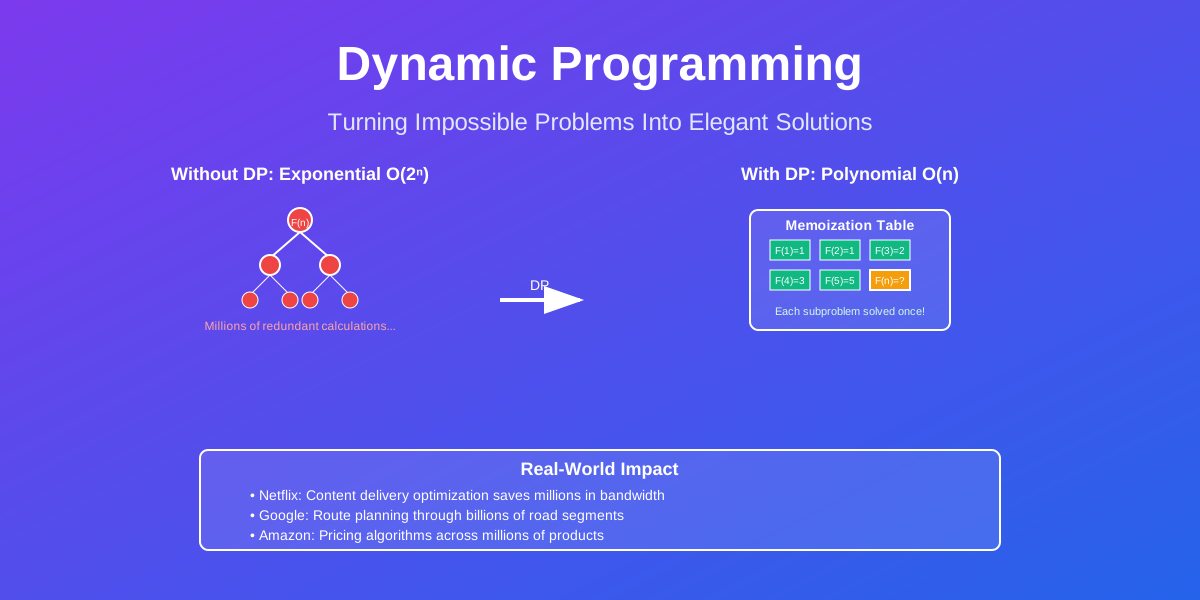
You’re staring at a problem that should be simple. Calculate the 50th Fibonacci number. Your recursive solution works perfectly for small numbers, but crashes your server when you try larger ones. The algorithm that should take milliseconds is running for hours.
Then you discover dynamic programming.
One small change—storing previous results instead of recalculating them—drops execution time from hours to microseconds. That’s not just optimization. That’s transformation.
This isn’t just about Fibonacci numbers. Netflix uses dynamic programming to optimize their content delivery network, saving millions in bandwidth costs. Google’s route planning algorithms rely on DP to find optimal paths through billions of road segments. Amazon’s pricing algorithms use DP to maximize revenue while staying competitive.
Here’s why dynamic programming isn’t just another algorithm—it’s a completely different way of thinking about problems.
The Moment Everything Clicked
I remember the exact moment dynamic programming made sense. I was working on a feature that calculated optimal pricing for different subscription tiers. The naive approach was checking every possible combination—millions of calculations that took forever.
My senior engineer showed me how to break it down: “What if we stored the optimal price for each tier as we calculated it?” Suddenly, instead of recalculating the same scenarios repeatedly, we were building up solutions from smaller pieces.
That’s dynamic programming in a nutshell. It’s not about being clever with algorithms—it’s about recognizing that most complex problems are just combinations of simpler problems we’ve already solved.
The key insight? Optimal substructure and overlapping subproblems. If your problem has these properties, DP can transform exponential complexity into polynomial time.
What Makes Dynamic Programming Special
Dynamic programming solves problems by breaking them into smaller subproblems, solving each subproblem once, and storing the results. It’s like having a perfect memory—you never solve the same problem twice.
But here’s what makes it powerful: it doesn’t just avoid redundant work. It fundamentally changes how you approach optimization problems.
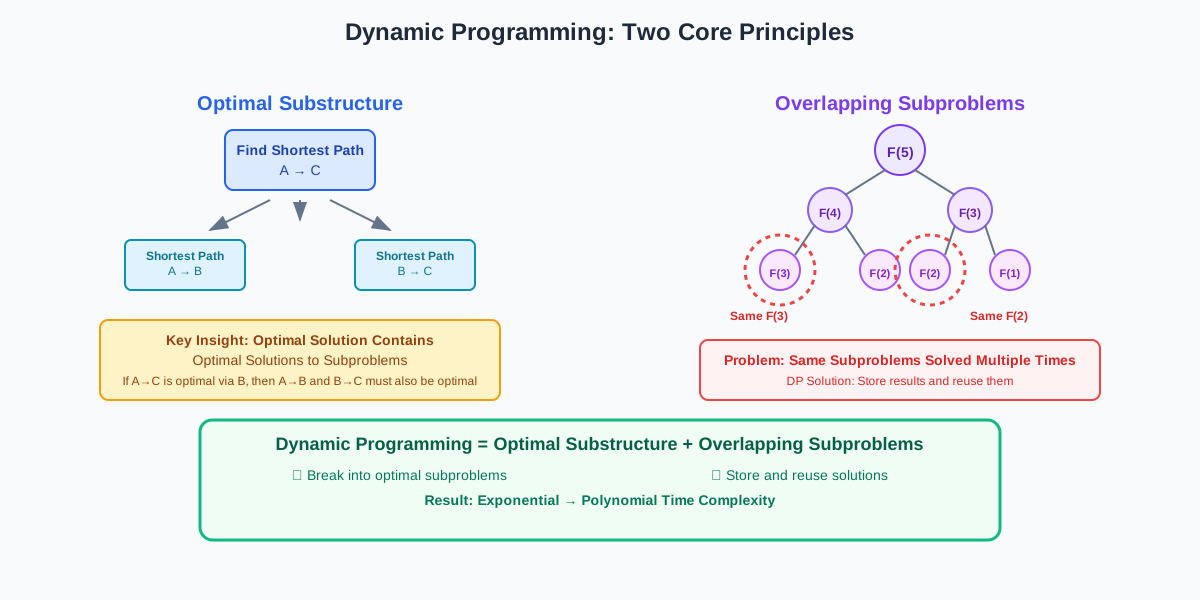
The Two Pillars of DP:
Optimal Substructure: The optimal solution contains optimal solutions to subproblems. If you’re finding the shortest path from A to C through B, the path from A to B must also be optimal.
Overlapping Subproblems: The same subproblems appear multiple times. Without DP, you’d solve them repeatedly. With DP, you solve them once and reuse the results.
This combination is what makes DP so effective for optimization problems that would otherwise be intractable.
The Two Faces of Dynamic Programming
Dynamic programming has two main approaches, and understanding both is crucial for real-world applications.
Memoization: Top-Down Thinking
Memoization starts with the original problem and breaks it down recursively, storing results as you go. It’s intuitive because it follows your natural problem-solving process.
Fibonacci with Memoization
When Netflix optimizes content recommendations, they use memoization to avoid recalculating user similarity scores. If they’ve already computed how similar User A is to User B, they store that result and reuse it across different recommendation contexts.
The beauty of memoization is that it’s often a simple modification to your recursive solution. Add a cache, check it before computing, store results after computing. Done.
Tabulation: Bottom-Up Building
Tabulation works in the opposite direction. You start with the smallest subproblems and build up to the final solution. It’s less intuitive but often more efficient.
Fibonacci with Tabulation
Google Maps uses tabulation for route optimization. Instead of recursively breaking down “shortest path from A to Z,” they build up optimal paths from each intersection to its neighbors, then combine those to find longer optimal paths.
Tabulation typically uses less memory (no recursion stack) and can be easier to optimize for space complexity.
Classic Problems That Showcase DP Power
Let’s look at problems that demonstrate why DP is so valuable in production systems.
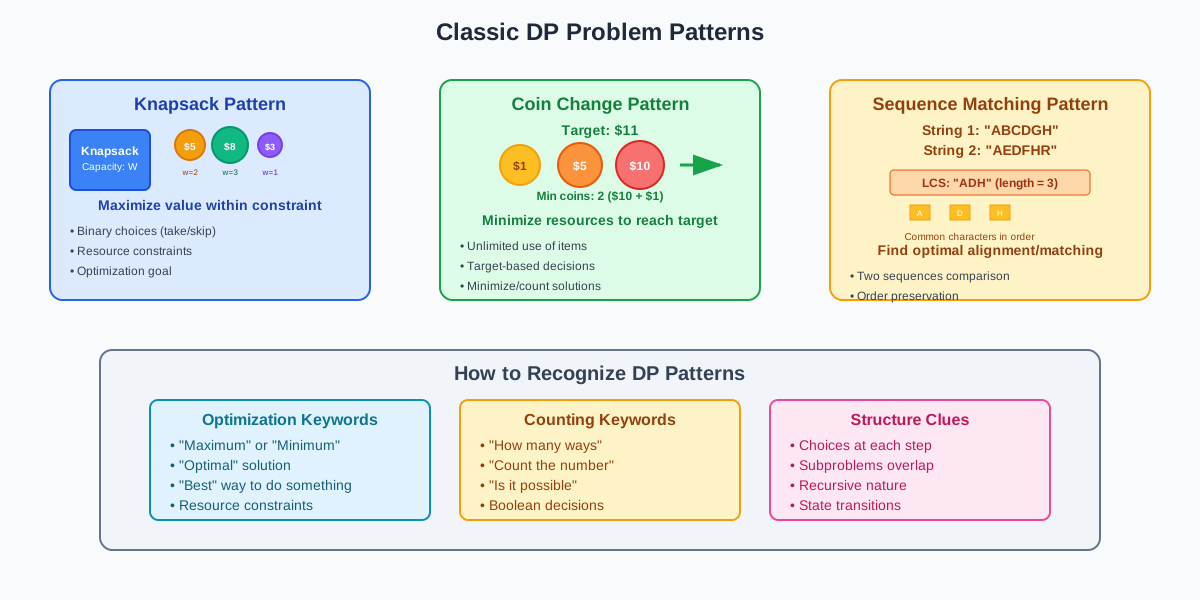
The Knapsack Problem: Resource Optimization
You have a knapsack with limited capacity and items with different weights and values. What’s the maximum value you can carry?
This isn’t just a textbook problem. Amazon’s warehouse optimization uses variations of knapsack algorithms to decide which products to stock in each fulfillment center. Limited space, different profit margins, varying demand—it’s knapsack at scale.
0/1 Knapsack Problem
Uber’s surge pricing also uses knapsack-style DP. They have limited driver capacity (the knapsack) and different ride requests with varying profitability (the items). The algorithm optimizes which rides to prioritize to maximize revenue.
Coin Change: Making Optimal Decisions
Given coins of different denominations, what’s the minimum number of coins needed to make a specific amount?
Stripe’s payment processing uses this pattern for currency conversion optimization. When processing international payments, they need to minimize transaction fees across different currency exchange paths.
Coin Change Problem
The DP solution builds up optimal solutions for smaller amounts and uses them to solve larger amounts efficiently.
Longest Common Subsequence: Finding Patterns
What’s the longest sequence of characters that appears in the same order in two strings?
GitHub’s diff algorithms use LCS to show you exactly what changed between file versions. Instead of highlighting every character difference, they find the longest common subsequence and show minimal, meaningful changes.
Longest Common Subsequence
Google Docs’ collaborative editing also relies on LCS variants to merge simultaneous edits from multiple users without conflicts.
Real-World Applications at Scale
Dynamic programming isn’t just for coding interviews. It’s solving billion-dollar problems in production.
Netflix: Content Delivery Optimization
Netflix streams to 230 million subscribers worldwide. Their content delivery network (CDN) uses DP to optimize which content to cache at which locations.
The problem: Limited storage at each CDN node, different content popularity in different regions, varying bandwidth costs. The solution: A multi-dimensional DP algorithm that maximizes cache hit rates while minimizing bandwidth costs.
They model it as a variant of the knapsack problem where each CDN node is a knapsack, content files are items with different sizes and values (based on local popularity), and the goal is maximizing global cache efficiency.
Google: Route Optimization
Google Maps processes billions of route requests daily. Their routing algorithms use DP to find optimal paths considering real-time traffic, road closures, and user preferences.
The classic shortest path problem becomes multi-dimensional: minimize time, distance, tolls, or fuel consumption. DP allows them to precompute optimal subpaths and combine them efficiently for any route request.
Their traffic prediction models also use DP to optimize traffic light timing across entire cities, reducing congestion by coordinating signals to create “green waves.”
Amazon: Pricing and Inventory
Amazon’s pricing algorithms use DP to optimize prices across millions of products while considering competitor prices, inventory levels, demand forecasts, and profit margins.
They model it as a sequential decision problem: for each product, at each time period, what price maximizes long-term profit? DP helps them balance immediate revenue with inventory turnover and competitive positioning.
Their warehouse robot routing also uses DP. With thousands of robots moving simultaneously, they need to optimize paths to avoid collisions while minimizing total travel time.
Facebook: News Feed Ranking
Facebook’s news feed algorithm uses DP for content selection optimization. With thousands of potential posts for each user, they need to select the optimal subset that maximizes engagement.
They model user attention as a limited resource (like knapsack capacity) and posts as items with different engagement values and “attention costs.” DP helps them find the combination that maximizes total engagement.
Advanced DP Techniques
Once you understand basic DP, these advanced techniques unlock even more powerful applications.
Space Optimization
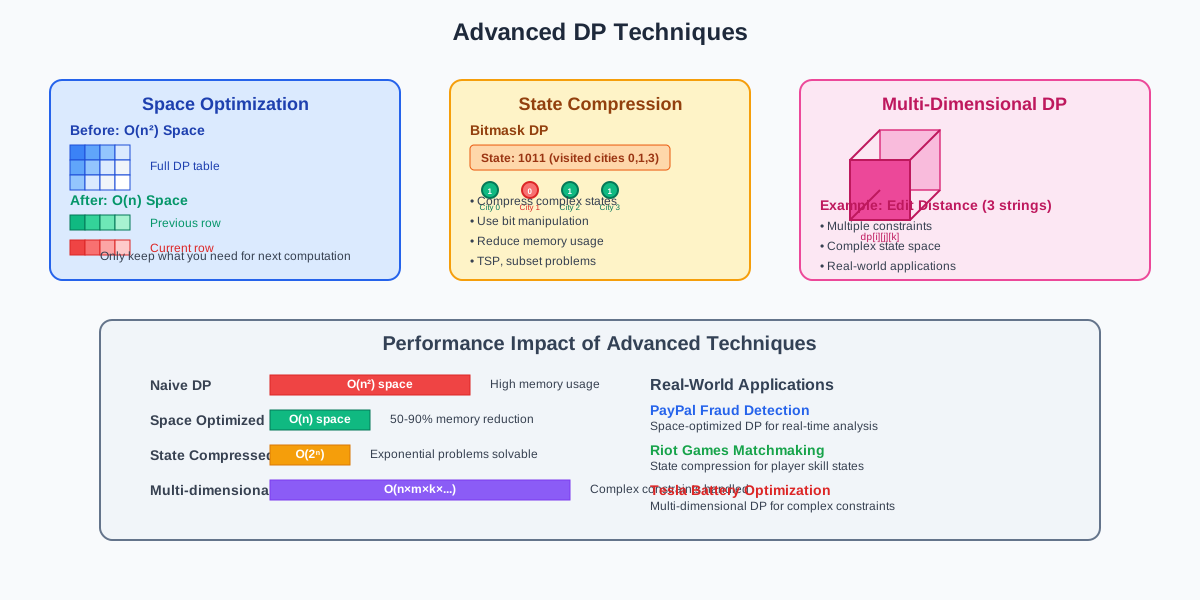
Many DP problems only need the previous row or column of results. You can often reduce space complexity from O(n²) to O(n).
Space-Optimized DP
PayPal’s fraud detection uses space-optimized DP to analyze transaction patterns in real-time. They can’t store full DP tables for millions of users, so they use rolling arrays to maintain only the necessary state.
State Compression
For problems with complex states, you can sometimes compress the state space using bit manipulation or mathematical properties.
Riot Games’ matchmaking uses state compression in their ELO rating system. Instead of storing full game histories, they compress player skill states into compact representations that still allow optimal matchmaking decisions.
Multi-Dimensional DP
Real problems often have multiple constraints. Multi-dimensional DP handles problems with several variables.
Multi-Dimensional DP
Tesla’s battery optimization uses multi-dimensional DP to balance range, performance, and battery longevity. The state space includes current charge, driving conditions, temperature, and usage patterns.
Common Pitfalls and How to Avoid Them
DP is powerful, but it’s easy to make mistakes that kill performance or correctness.
Pitfall 1: Incorrect State Definition
The most common mistake is defining your DP state incorrectly. Your state must capture all information needed to make optimal decisions.
I once spent hours debugging a DP solution that gave wrong answers. The problem? My state didn’t include a crucial constraint. Always ask: “What information do I need to make the optimal choice at each step?”
Pitfall 2: Missing Base Cases
DP solutions need proper base cases. Missing or incorrect base cases lead to infinite recursion or wrong answers.
Shopify learned this when their inventory optimization algorithm crashed during Black Friday. They’d missed edge cases in their DP base conditions, causing failures when inventory levels hit zero.
Pitfall 3: Inefficient State Transitions
Just because you’re using DP doesn’t mean it’s optimal. Inefficient transitions can make your solution slower than brute force.
DoorDash’s delivery routing initially used DP with O(n³) transitions per state. Optimizing the transition logic to O(n) made their algorithm 100x faster during peak hours.
Pitfall 4: Memory Overflow
DP can use enormous amounts of memory if you’re not careful. Always consider space optimization techniques.
Zoom’s video compression uses DP for optimal encoding decisions, but they had to implement sophisticated memory management to handle 4K video streams without running out of RAM.
When NOT to Use Dynamic Programming
DP isn’t always the answer. Here’s when to avoid it:
When subproblems don’t overlap: If you’re not solving the same subproblems multiple times, DP adds unnecessary complexity.
When the state space is too large: If your DP table would be enormous, consider approximation algorithms or different approaches.
When greedy algorithms work: Some problems have greedy solutions that are simpler and just as efficient.
When the problem doesn’t have optimal substructure: If optimal solutions don’t contain optimal subsolutions, DP won’t work.
Interview Mastery: Recognizing DP Problems
In technical interviews, recognizing DP problems is half the battle. Here are the telltale signs:
Keywords that suggest DP:
- “Optimal” or “maximum/minimum”
- “Count the number of ways”
- “Is it possible to…”
- “Find all possible…”
Problem patterns:
- Decision problems with choices at each step
- Optimization problems with constraints
- Counting problems with overlapping cases
- String/sequence problems with matching
The DP checklist:
- Can I break this into smaller subproblems?
- Do subproblems overlap?
- Does the optimal solution contain optimal subsolutions?
- Can I define a recurrence relation?
If you answer “yes” to all four, it’s likely a DP problem.
Building Your DP Intuition
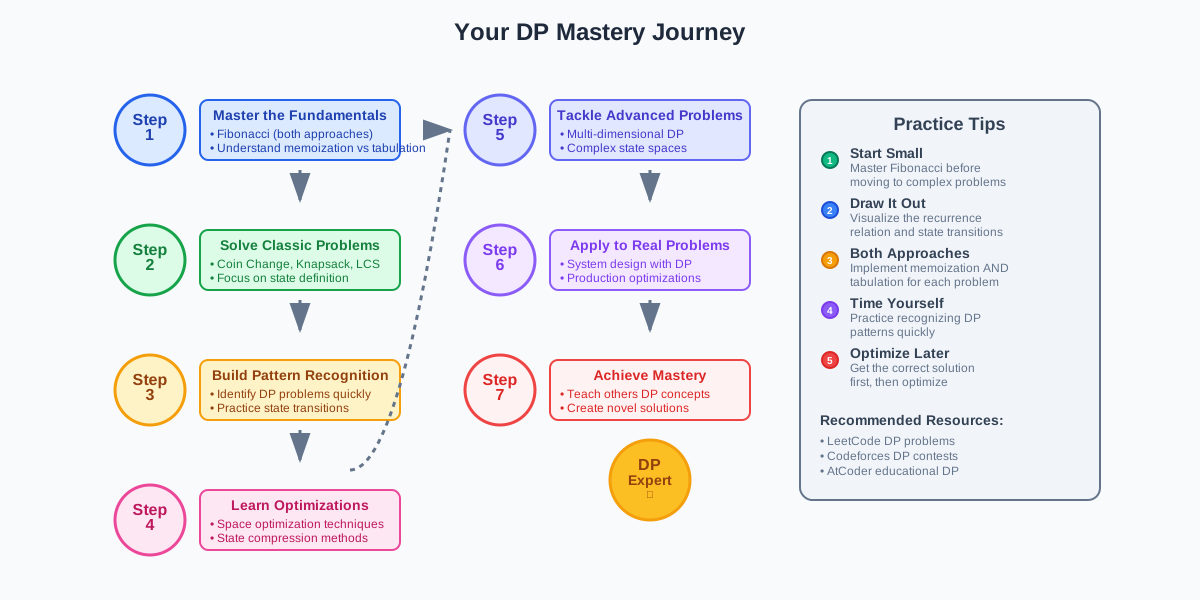
The best way to master DP is to practice recognizing patterns and building intuition.
Start with classic problems: Fibonacci, coin change, knapsack, LCS. Understand them deeply before moving to variations.
Focus on state definition: Spend time thinking about what your DP state should represent. This is usually the hardest part.
Draw the recurrence: Visualize how subproblems relate to each other. Drawing helps you see the pattern.
Implement both approaches: Try both memoization and tabulation for the same problem. This builds deeper understanding.
Optimize incrementally: Start with a working solution, then optimize for space or time.
The Future of Dynamic Programming
DP continues evolving with new applications in machine learning, quantum computing, and distributed systems.
Machine Learning: Reinforcement learning algorithms like Q-learning are essentially DP applied to decision-making under uncertainty.
Quantum Computing: Quantum algorithms use DP principles to optimize quantum gate sequences and error correction.
Distributed Systems: Modern distributed DP algorithms solve optimization problems across multiple machines, enabling solutions to previously intractable problems.
Approximate DP: When exact DP is too expensive, approximate DP techniques provide near-optimal solutions with bounded error guarantees.
Key Takeaways
Dynamic programming transforms impossible problems into elegant solutions by recognizing that complex problems are often combinations of simpler ones.
The core insight: Store solutions to subproblems and reuse them. This simple idea can reduce exponential algorithms to polynomial time.
Two approaches: Memoization (top-down) is intuitive, tabulation (bottom-up) is often more efficient.
Recognition patterns: Look for optimal substructure and overlapping subproblems. Keywords like “optimal,” “maximum,” and “count ways” are strong hints.
Real-world impact: DP powers critical systems at Netflix, Google, Amazon, and countless other companies. It’s not just academic—it’s solving billion-dollar problems.
Common mistakes: Incorrect state definition, missing base cases, inefficient transitions, and memory overflow. Always validate your approach with small examples.
The beauty of DP is that once you understand the pattern, you start seeing it everywhere. Optimization problems that seemed impossible become straightforward applications of principles you already know.
What’s Next?
Dynamic programming opens doors to advanced algorithms and system design patterns. Once you’re comfortable with DP, explore:
- Advanced graph algorithms that use DP for optimization
- Machine learning algorithms built on DP principles
- System design problems where DP provides optimal resource allocation
- Competitive programming where DP is essential for complex problems
The patterns you learn with DP—breaking problems into subproblems, recognizing optimal substructure, managing state efficiently—apply far beyond algorithms. They’re fundamental problem-solving skills that will serve you throughout your career.
Want to discuss specific DP problems or share how you’re applying these concepts? Reach out—I’d love to hear about the optimization challenges you’re tackling.
Remember: every expert was once a beginner who learned to see problems differently. DP teaches you to see optimization opportunities everywhere.
Comments & Discussion
Join the conversation! Share your thoughts, ask questions, or provide feedback below.