You’re building a Sudoku solver for your mobile app. The naive approach? Try every possible number in every cell until you find a solution. That’s 9^81 possibilities—more combinations than atoms in the observable universe.
Your app would literally take longer than the age of the universe to solve a single puzzle.
Then you discover backtracking.
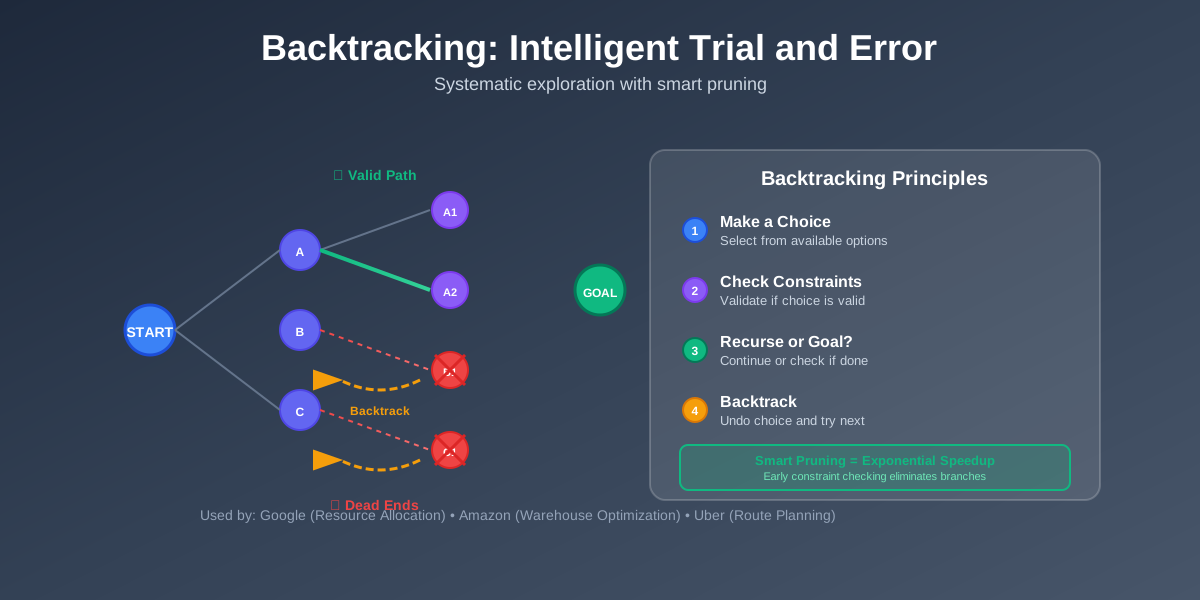
Instead of blindly trying everything, backtracking makes intelligent choices. When it hits a dead end, it backs up and tries a different path. Your Sudoku solver now finds solutions in milliseconds, not millennia.
This isn’t just about puzzles. Google uses backtracking for constraint satisfaction in their resource allocation systems. Amazon applies it to optimize warehouse robot paths when they encounter obstacles. Uber’s route planning algorithms use backtracking variants to handle real-time traffic constraints.
Here’s why backtracking isn’t just another algorithm—it’s a fundamental problem-solving paradigm that turns impossible problems into elegant solutions.
The Moment I Understood Backtracking
I was working on a feature that needed to generate all possible combinations of product bundles for an e-commerce platform. My first attempt used nested loops—it worked for small datasets but crashed when we scaled to hundreds of products.
My mentor showed me a different approach: “What if we build solutions step by step, and when we realize we’re going down the wrong path, we just undo our last choice and try something else?”
That’s backtracking in a nutshell. It’s like solving a maze by always keeping your hand on the wall—when you hit a dead end, you retrace your steps until you find a new path to explore.
The key insight? Systematic exploration with intelligent abandonment. You don’t waste time exploring paths that can’t possibly lead to a solution.
What Makes Backtracking Special
Backtracking is a systematic method for solving problems by trying partial solutions and abandoning them (“backtracking”) as soon as it’s determined they can’t lead to a complete solution.
Think of it as a smart brute force approach. While brute force blindly tries everything, backtracking uses constraints to prune the search space dramatically.
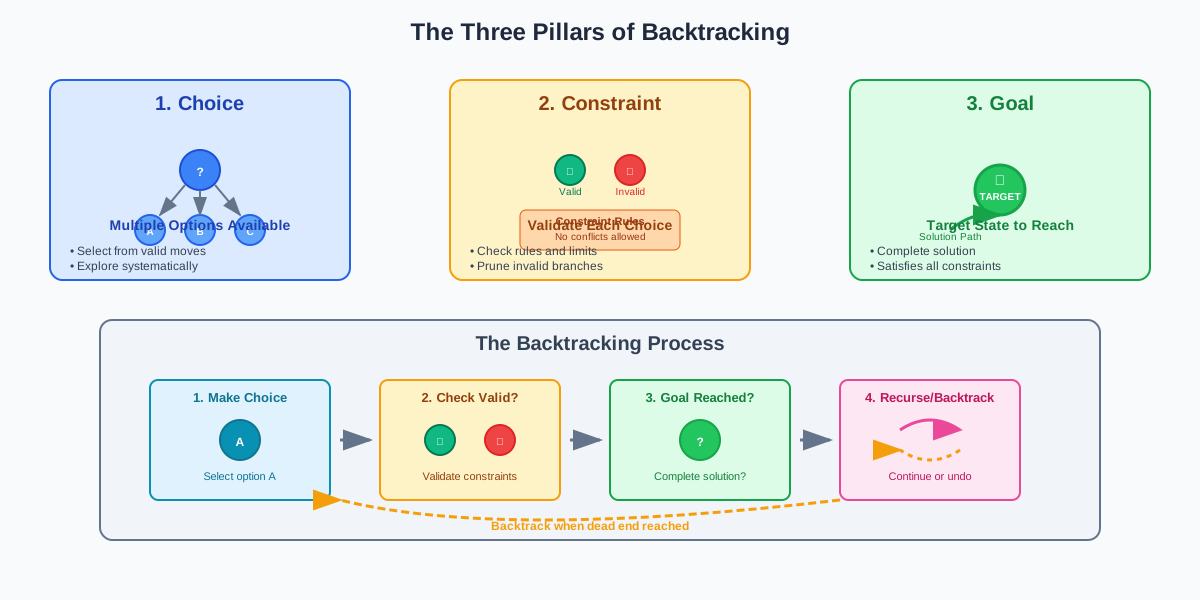
The Three Pillars of Backtracking:
Choice: At each step, you have multiple options to choose from.
Constraint: Some choices are invalid based on the current state.
Goal: You’re trying to reach a specific target state.
The magic happens in the pruning. When backtracking detects that a partial solution can’t possibly lead to a valid complete solution, it abandons that entire branch of possibilities.
The Backtracking Template
Every backtracking algorithm follows the same basic pattern:
Backtracking Template
This template is incredibly powerful because it separates the problem-specific logic (what are valid choices? when have we reached a goal?) from the search strategy.
Netflix uses this exact pattern for their content recommendation algorithms. They explore different combinations of user preferences, backing out when a path won’t lead to engaging recommendations.
Classic Problems That Showcase Backtracking Power
Let’s explore problems that demonstrate why backtracking is so valuable in production systems.
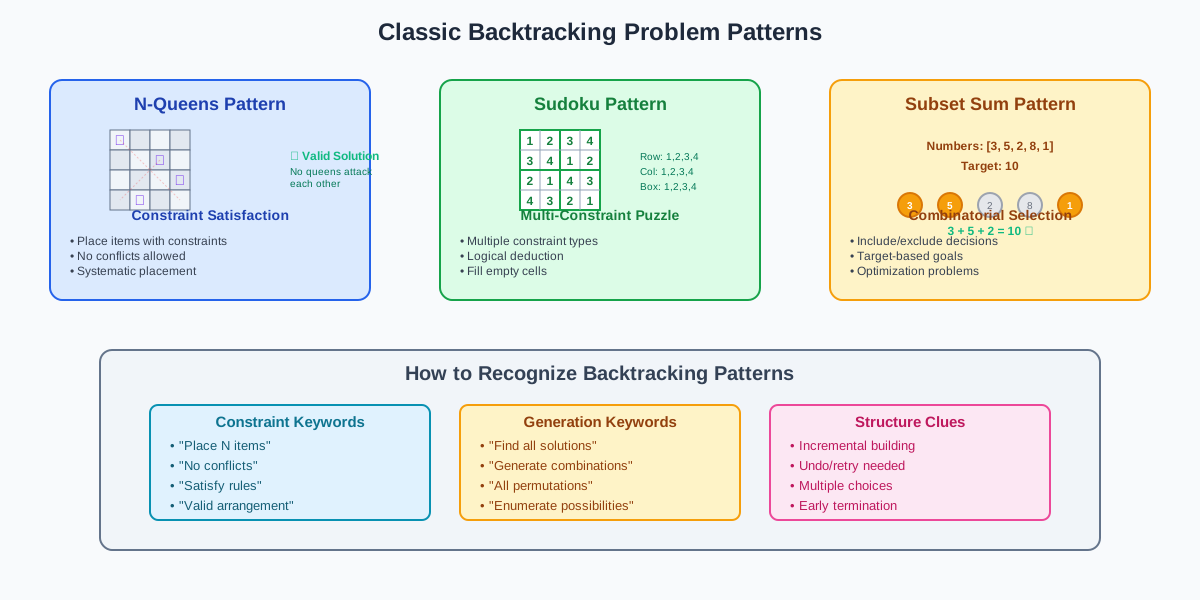
N-Queens: The Constraint Satisfaction Classic
Place N queens on an N×N chessboard so that no two queens attack each other.
This problem perfectly illustrates backtracking’s strength with constraint satisfaction. Instead of trying all possible placements (which would be astronomical), we place queens one row at a time and immediately backtrack when we violate constraints.
N-Queens Problem
Google’s resource allocation systems use N-Queens-style algorithms to assign computational resources to different services while avoiding conflicts and maintaining performance constraints.
The beauty is in the pruning. When we place a queen that attacks a previously placed queen, we immediately know this path is invalid—no need to explore the millions of possibilities that branch from this state.
Sudoku Solver: Logical Deduction Meets Search
Fill a 9×9 grid so that each row, column, and 3×3 box contains all digits 1-9.
Sudoku Solver
Microsoft’s Excel uses backtracking algorithms in their constraint solver for complex spreadsheet calculations. When you set up equations with multiple variables and constraints, Excel explores different value assignments, backtracking when constraints are violated.
Subset Sum: The Optimization Challenge
Given a set of numbers and a target sum, find if there’s a subset that adds up to the target.
Subset Sum with Backtracking
Amazon’s warehouse optimization uses subset sum variants to determine optimal product combinations for shipping containers. They need to maximize container utilization while respecting weight and volume constraints.
Real-World Applications at Scale
Backtracking isn’t just for textbook problems. It’s solving billion-dollar challenges in production.
Google: Constraint Satisfaction in Data Centers
Google’s data centers run millions of services across thousands of machines. They use backtracking-based algorithms to assign services to machines while satisfying constraints like:
- Memory and CPU requirements
- Network locality preferences
- Fault tolerance requirements
- Power consumption limits
When a service placement violates constraints, the algorithm backtracks and tries a different assignment. This happens thousands of times per second as services start, stop, and migrate.
Their constraint solver reduced resource waste by 15% compared to greedy allocation algorithms, saving millions in infrastructure costs.
Uber: Dynamic Route Optimization
Uber’s route planning faces a complex constraint satisfaction problem. They need to find optimal paths while considering:
- Real-time traffic conditions
- Driver preferences and restrictions
- Passenger pickup/dropoff constraints
- Fuel efficiency requirements
When traffic suddenly blocks a planned route, their backtracking algorithms quickly explore alternative paths, undoing previous routing decisions that are no longer optimal.
During peak hours, this system processes over 100,000 route recalculations per minute, with backtracking enabling sub-second response times even when multiple constraints change simultaneously.
Amazon: Inventory Allocation Optimization
Amazon’s fulfillment centers use backtracking for inventory allocation across their network. The problem: decide which warehouse should fulfill each order to minimize shipping costs while maintaining delivery promises.
Constraints include:
- Inventory availability at each location
- Shipping capacity limits
- Delivery time requirements
- Cost optimization targets
When an allocation decision creates downstream conflicts (like overloading a shipping hub), the algorithm backtracks and redistributes orders differently.
This system processes over 1 million allocation decisions daily, with backtracking reducing shipping costs by 8% compared to greedy allocation strategies.
Facebook: Content Moderation Workflows
Facebook uses backtracking algorithms for content moderation workflow optimization. They need to assign content review tasks to human moderators while satisfying:
- Moderator expertise areas
- Workload balancing requirements
- Language and cultural context needs
- Urgency and priority constraints
When a moderator assignment creates bottlenecks or expertise mismatches, the system backtracks and redistributes tasks to maintain review quality and speed.
Advanced Backtracking Techniques
Once you understand basic backtracking, these advanced techniques unlock even more powerful applications.
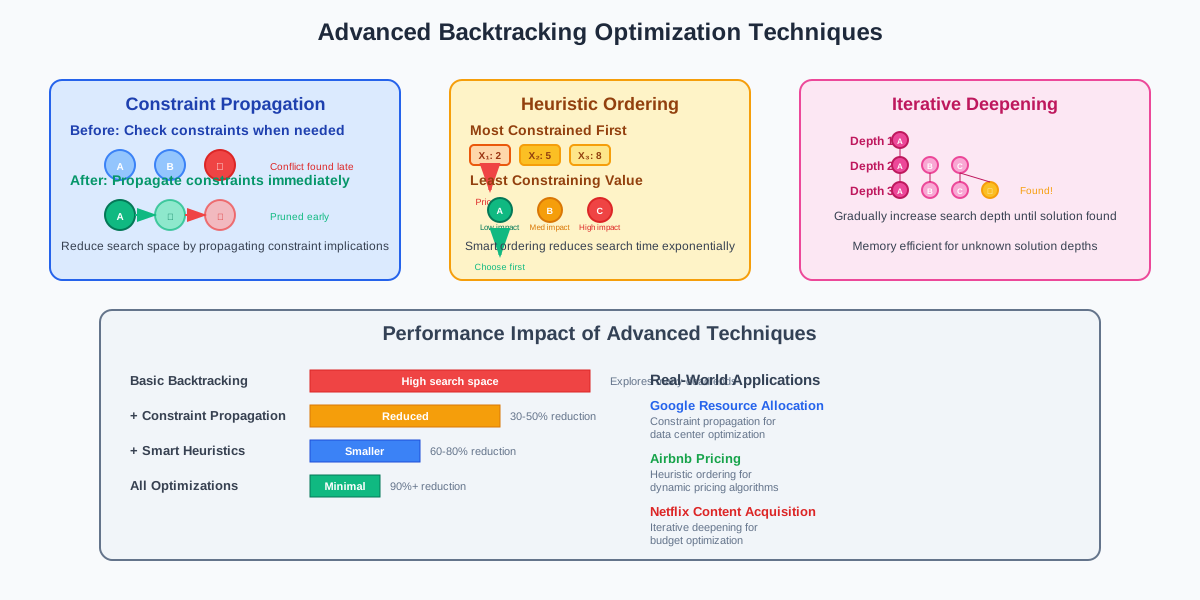
Constraint Propagation
Instead of just checking constraints when we make a choice, we can propagate the implications of each choice to reduce future options.
Constraint Propagation
Airbnb’s pricing optimization uses constraint propagation in their dynamic pricing algorithms. When they set a price for one property, they propagate the implications to similar properties in the area, reducing the search space for optimal pricing across their entire inventory.
Heuristic Ordering
The order in which we explore choices dramatically affects performance. Smart heuristics can reduce search time by orders of magnitude.
Heuristic-Guided Backtracking
Netflix’s content acquisition uses heuristic ordering when deciding which shows to license. They prioritize exploring content that’s most likely to engage their target demographics, backtracking only when budget or licensing constraints make a choice infeasible.
Iterative Deepening
For problems where we don’t know the optimal solution depth, we can use iterative deepening to gradually increase our search depth.
Iterative Deepening Backtracking
Google’s query optimization uses iterative deepening when generating search result combinations. They start with simple result sets and gradually explore more complex combinations until they find the optimal user experience.
Common Pitfalls and How to Avoid Them
Backtracking is powerful, but it’s easy to make mistakes that kill performance or correctness.
Pitfall 1: Inefficient Constraint Checking
The most common mistake is checking constraints inefficiently. If constraint checking is expensive, your algorithm becomes unusably slow.
I once worked on a scheduling system where we checked all constraints from scratch at every step. What should have taken seconds took hours. The fix? Incremental constraint checking—only verify what changed.
Spotify learned this when optimizing their playlist generation algorithms. Initially, they recalculated all music similarity scores at each step. Switching to incremental updates reduced generation time by 90%.
Pitfall 2: Poor Choice Ordering
The order you explore choices can make the difference between milliseconds and hours. Always explore the most constrained or most promising choices first.
DoorDash’s delivery routing initially explored restaurant assignments randomly. Switching to a “most constrained first” heuristic (restaurants with the fewest available drivers) reduced route calculation time by 75%.
Pitfall 3: Missing Pruning Opportunities
Every constraint violation is a chance to prune the search tree. Missing these opportunities leads to exponential slowdown.
Zillow’s property recommendation engine initially only checked budget constraints at the end of the search. Moving constraint checks earlier in the process eliminated 95% of unnecessary computations.
Pitfall 4: Stack Overflow from Deep Recursion
Backtracking algorithms can recurse very deeply, causing stack overflow errors.
LinkedIn’s connection suggestion algorithms hit this issue when exploring social network paths. They switched to iterative implementations with explicit stacks, eliminating the recursion depth limit.
When NOT to Use Backtracking
Backtracking isn’t always the answer. Here’s when to avoid it:
When the search space is too large: If pruning doesn’t significantly reduce the search space, backtracking becomes impractical.
When greedy algorithms work: Some problems have optimal greedy solutions that are much simpler and faster.
When dynamic programming applies: If the problem has optimal substructure and overlapping subproblems, DP is usually better.
When approximation is acceptable: If you don’t need the optimal solution, heuristic algorithms might be faster.
Interview Mastery: Recognizing Backtracking Problems
In technical interviews, recognizing backtracking problems is crucial. Here are the telltale signs:
Keywords that suggest backtracking:
- “Find all possible…”
- “Generate all combinations/permutations”
- “Is it possible to…”
- “Place/arrange items with constraints”
Problem patterns:
- Constraint satisfaction problems
- Combinatorial generation problems
- Puzzle-solving problems
- Path-finding with obstacles
The backtracking checklist:
- Do I need to explore multiple possibilities?
- Can I build solutions incrementally?
- Can I detect invalid partial solutions early?
- Do I need to undo choices and try alternatives?
If you answer “yes” to all four, it’s likely a backtracking problem.
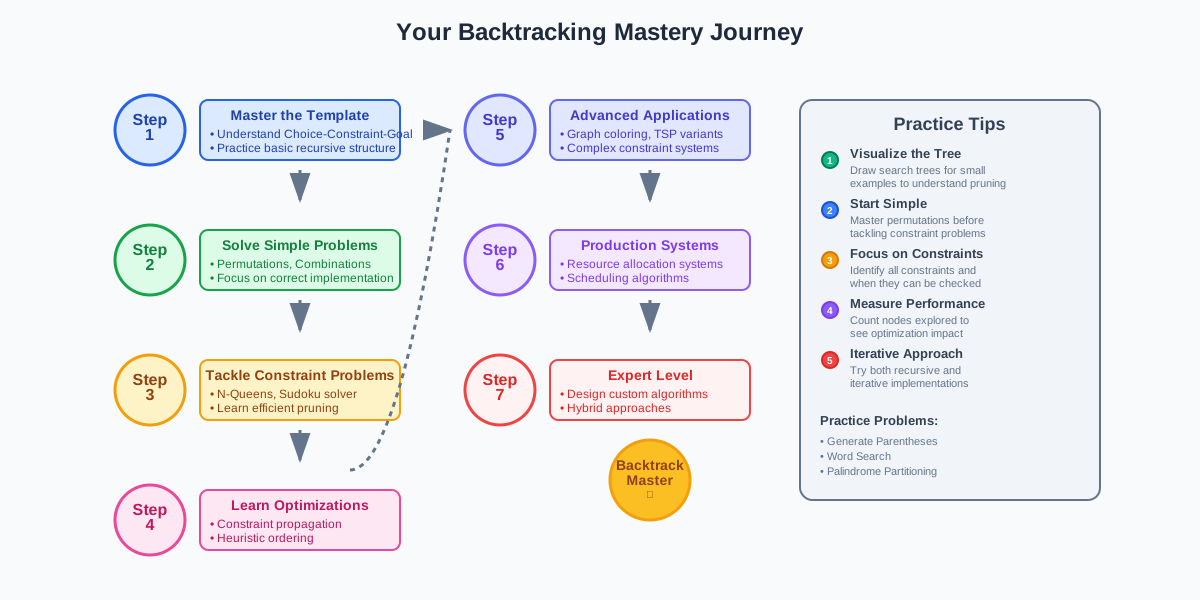
Building Your Backtracking Intuition
The best way to master backtracking is to practice recognizing patterns and building intuition.
Start with visualization: Draw the search tree for small examples. Understanding how backtracking explores and prunes the tree is crucial.
Focus on constraints: Spend time identifying all constraints and when they can be checked. Early constraint checking is the key to efficient backtracking.
Practice pruning: For each problem, ask “What information tells me this path can’t lead to a solution?” The more aggressively you can prune, the faster your algorithm.
Implement both approaches: Try both recursive and iterative implementations. This builds deeper understanding of the algorithm’s mechanics.
Optimize incrementally: Start with a correct solution, then optimize constraint checking, choice ordering, and pruning.
The Future of Backtracking
Backtracking continues evolving with new applications in machine learning, quantum computing, and distributed systems.
Machine Learning: Reinforcement learning algorithms use backtracking-like exploration strategies to discover optimal policies in complex environments.
Quantum Computing: Quantum algorithms use backtracking principles to explore quantum state spaces efficiently.
Distributed Systems: Modern distributed constraint solvers use backtracking across multiple machines to solve problems that would be intractable on single systems.
AI Planning: Advanced AI planning systems combine backtracking with machine learning to solve complex real-world scheduling and resource allocation problems.
Key Takeaways
Backtracking transforms impossible problems into manageable ones by combining systematic exploration with intelligent pruning.
The core insight: Build solutions incrementally and abandon paths as soon as you know they can’t succeed.
Three essential components: Choice (what options do I have?), Constraint (what’s valid?), and Goal (what am I trying to achieve?).
Performance keys: Efficient constraint checking, smart choice ordering, and aggressive pruning make the difference between practical and impractical algorithms.
Real-world impact: Backtracking powers critical systems at Google, Amazon, Uber, and countless other companies. It’s not just academic—it’s solving billion-dollar problems.
Common mistakes: Inefficient constraint checking, poor choice ordering, missed pruning opportunities, and stack overflow from deep recursion.
The beauty of backtracking is its generality. Once you understand the pattern, you can apply it to an enormous range of problems. From puzzle solving to resource allocation, from scheduling to optimization—backtracking provides a systematic way to explore complex solution spaces efficiently.
What’s Next?
Backtracking opens doors to advanced algorithmic thinking and system design patterns. Once you’re comfortable with backtracking, explore:
- Constraint satisfaction programming for complex real-world optimization
- Branch and bound algorithms that combine backtracking with optimization bounds
- Game tree search algorithms used in AI and game development
- SAT solvers that power modern verification and optimization tools
The patterns you learn with backtracking—systematic exploration, intelligent pruning, constraint propagation—apply far beyond algorithms. They’re fundamental problem-solving skills that will serve you throughout your career.
Want to discuss specific backtracking problems or share how you’re applying these concepts? Reach out—I’d love to hear about the constraint satisfaction challenges you’re tackling.
Remember: every expert was once a beginner who learned to see problems as search spaces waiting to be explored systematically.
Comments & Discussion
Join the conversation! Share your thoughts, ask questions, or provide feedback below.