Your database is handling millions of queries per second. Users expect instant results. A single slow query cascades into timeouts, angry customers, and lost revenue.
You’ve optimized everything—indexes, caching, query plans. But there’s still a bottleneck. The problem isn’t your code or your hardware.
It’s your tree structure.
Basic binary search trees degrade to linked lists under certain insertion patterns. Your O(log n) operations become O(n). What should take milliseconds takes seconds.
Then you discover self-balancing trees.
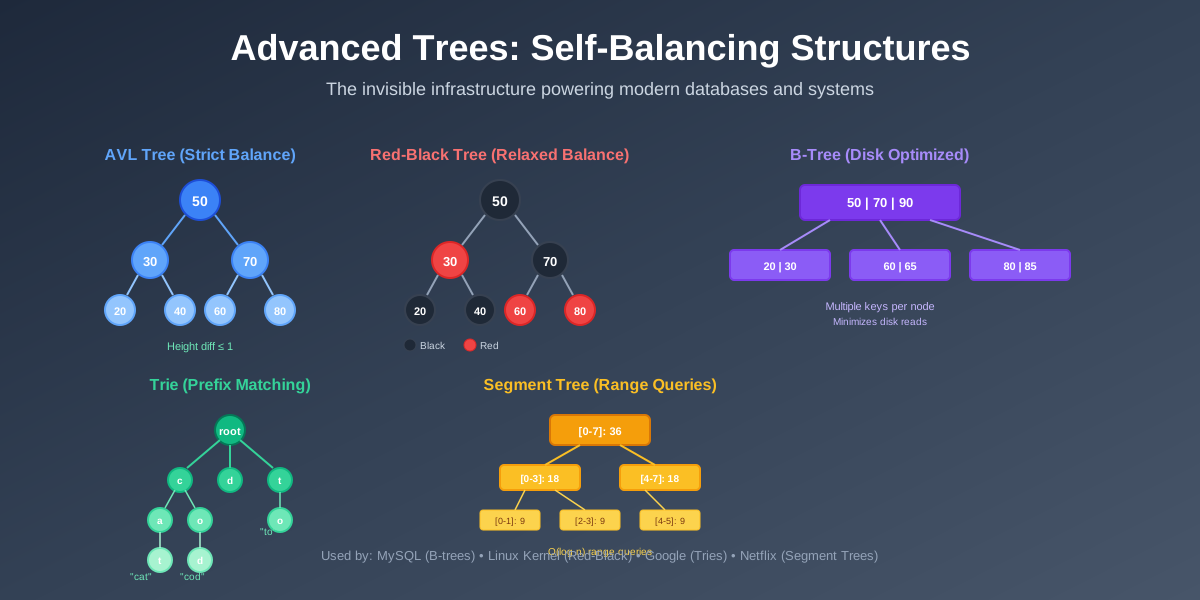
Google’s Bigtable uses B-trees to maintain sorted data across petabytes of storage. MySQL’s InnoDB engine relies on B+ trees for every index lookup. Redis uses skip lists (a probabilistic tree variant) to power sorted sets that handle millions of operations per second.
These aren’t academic curiosities. They’re the invisible infrastructure keeping the internet fast.
The Day I Learned Trees Could Lie
I was building a search feature for an e-commerce platform. We had a simple BST for product categories. Worked great in testing with our carefully randomized test data.
Then we launched.
Within hours, the system crawled to a halt. Our “balanced” tree wasn’t balanced at all. Real users added categories alphabetically. Our tree became a glorified linked list.
My senior engineer pulled up the code. “You need a self-balancing tree. BSTs are great until they’re not.”
That’s when I learned the difference between theoretical performance and real-world behavior. Self-balancing trees guarantee O(log n) operations no matter what order data arrives. No surprises, no degradation.
Why Advanced Trees Matter
Basic trees are fine for small datasets or controlled environments. But production systems face chaos—unpredictable insertion orders, skewed data distributions, concurrent modifications.
Advanced trees handle this chaos through automatic rebalancing, specialized structures, and clever invariants that maintain performance guarantees.
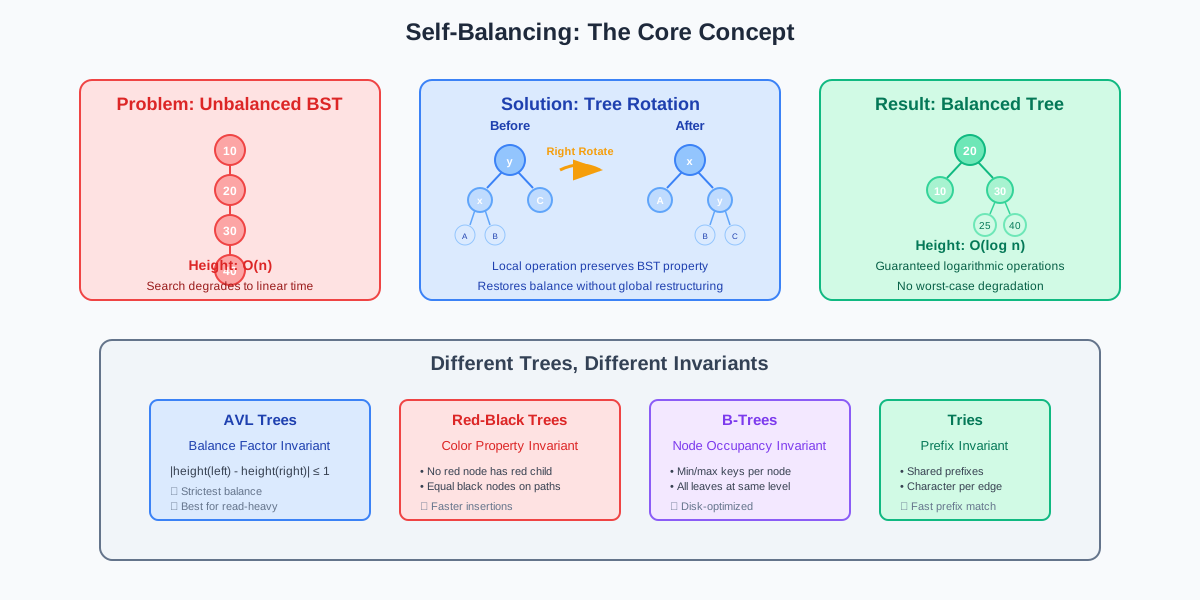
The core insight: Different problems need different tree structures. There’s no one-size-fits-all solution.
AVL trees prioritize strict balance for read-heavy workloads. Red-Black trees trade some balance for faster insertions. B-trees optimize for disk access patterns. Segment trees excel at range queries. Tries dominate prefix matching.
Understanding when to use each structure separates good engineers from great ones.
AVL Trees: The Perfectionist’s Choice
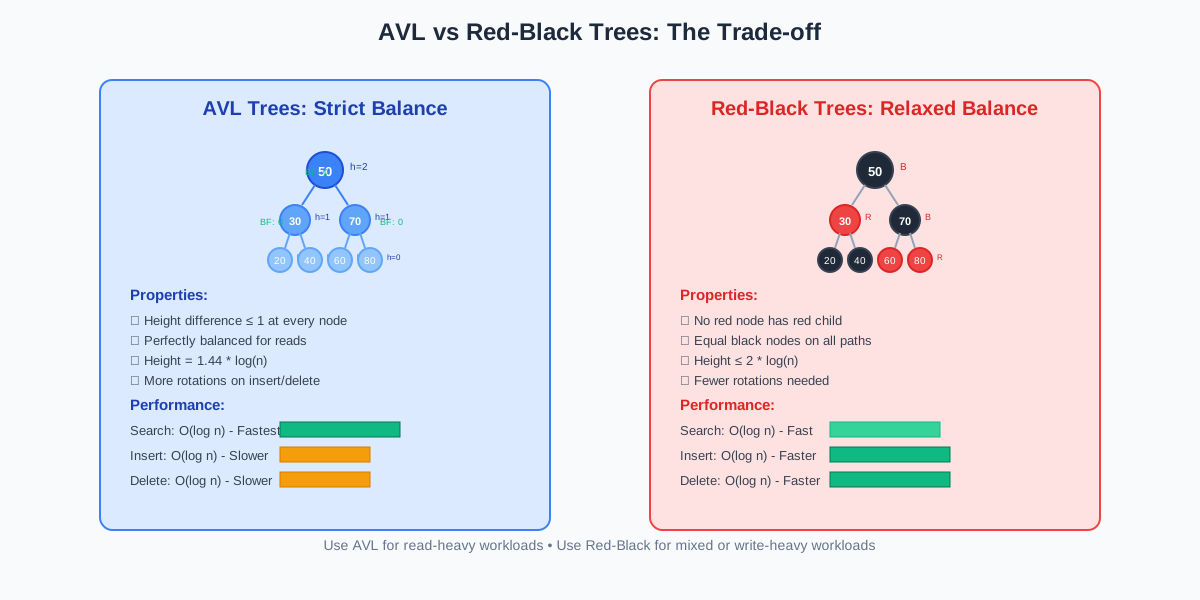
AVL trees maintain the strictest balance guarantee—the height difference between left and right subtrees never exceeds one.
This obsessive balance makes them perfect for read-heavy workloads where you need guaranteed fast lookups.
AVL Tree Insertion
The rotation dance: When an insertion violates the balance property, AVL trees perform rotations to restore balance. Four cases: left-left, left-right, right-left, right-right.
Sounds complex, but it’s elegant. Each rotation is a local operation that fixes the imbalance without touching the rest of the tree.
Google’s Protocol Buffers use AVL-like structures internally for maintaining sorted field maps. The strict balance guarantees consistent serialization performance across different message sizes.
When AVL trees shine: Dictionary implementations, database indexes for read-heavy tables, autocomplete systems where lookup speed is critical.
When they don’t: Write-heavy workloads. The strict balancing requires more rotations on insertion, making them slower than Red-Black trees for frequent updates.
Red-Black Trees: The Pragmatist’s Balance
Red-Black trees relax AVL’s strict balance rules. Instead of height differences, they use color properties to maintain “good enough” balance.
The result? Faster insertions and deletions with slightly slower lookups. For most real-world workloads, this trade-off wins.
Red-Black Tree Insertion
The color rules: Every node is red or black. Root is black. Red nodes can’t have red children. Every path from root to leaf has the same number of black nodes.
These simple rules guarantee the tree height stays within 2 * log(n), giving us O(log n) operations with fewer rotations than AVL trees.
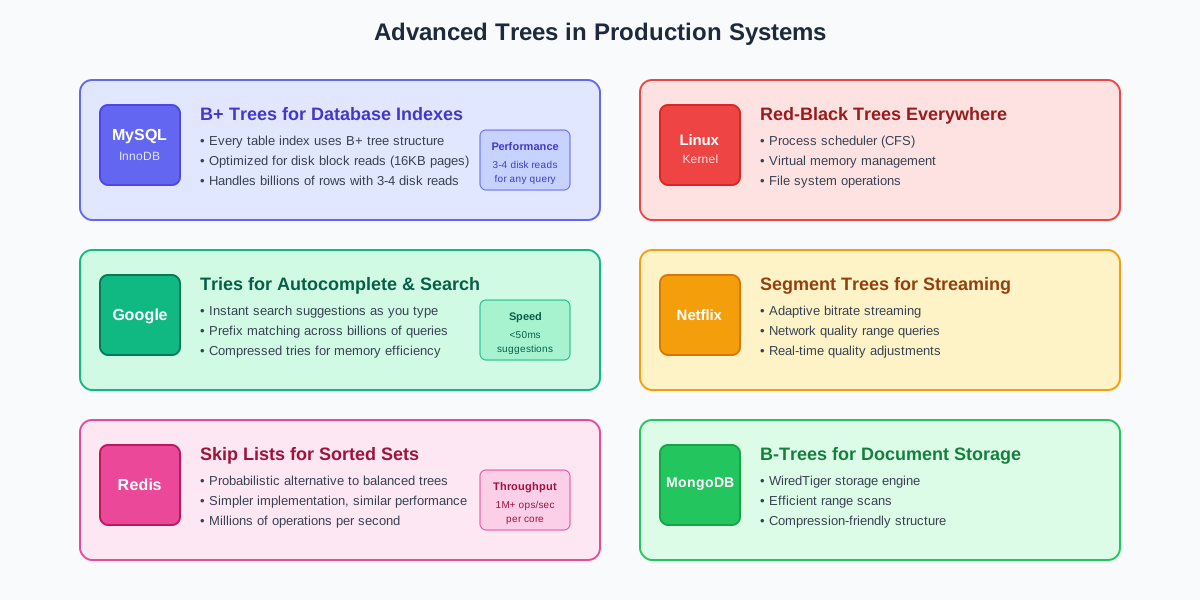
Linux kernel uses Red-Black trees extensively—for process scheduling (Completely Fair Scheduler), virtual memory management, and file system operations. The kernel needs fast insertions and deletions more than perfect balance.
Java’s TreeMap and TreeSet are implemented with Red-Black trees. When you use a sorted map in Java, you’re using this structure.
C++ STL’s map, set, multimap, and multiset all use Red-Black trees under the hood. Millions of applications rely on this structure without knowing it.
B-Trees: Optimized for Disk Access
B-trees are designed for one thing: minimizing disk reads. In a world where RAM access takes nanoseconds but disk access takes milliseconds, this matters enormously.
Unlike binary trees with two children per node, B-trees have hundreds or thousands of children. This reduces tree height dramatically.
B-Tree Search
The disk access insight: Reading 4KB from disk takes the same time whether you read 1 byte or 4KB. B-trees pack each node with as much data as fits in a disk block.
A B-tree with 1 million keys might have height 3. That’s 3 disk reads to find any key. A binary tree would need 20 disk reads.
MySQL’s InnoDB engine uses B+ trees (a B-tree variant) for all indexes. Every time you query a database, you’re traversing a B+ tree.
PostgreSQL, MongoDB, SQLite—virtually every database uses B-trees or variants. They’re the foundation of modern data storage.
File systems use B-trees too. NTFS, ext4, Btrfs all rely on B-tree variants to maintain directory structures and file metadata.
Amazon DynamoDB uses B-trees internally for maintaining sorted key ranges across distributed storage nodes.
Segment Trees: Range Query Champions
Segment trees solve a specific problem brilliantly: answering range queries efficiently while supporting updates.
Want to find the sum of elements from index 100 to 500 in an array? Segment trees do it in O(log n) time. Update any element? Also O(log n).
Segment Tree Range Query
The recursive structure: Each node represents a range. The root represents the entire array. Children represent halves of the parent’s range.
To query a range, you combine results from the minimal set of nodes that cover your range. Brilliant in its simplicity.
Competitive programming loves segment trees. They’re the go-to structure for range query problems.
Google’s data analytics pipelines use segment tree concepts for efficient time-range queries over massive datasets. When you query “show me all events between 2pm and 4pm yesterday,” segment trees make it fast.
Stock trading platforms use segment trees for real-time range queries—finding min/max prices over time windows, calculating moving averages, detecting price patterns.
Netflix’s video streaming uses segment tree concepts for adaptive bitrate streaming. They need to quickly query network quality over time ranges to decide which video quality to stream.
Tries: Prefix Matching Perfection
Tries (pronounced “try”) are specialized trees for string operations. Each path from root to leaf represents a string, with each node representing a character.
They excel at prefix matching, autocomplete, and spell checking.
Trie Insertion and Search
The prefix insight: Words sharing prefixes share tree paths. “cat”, “car”, and “card” share the “ca” prefix, so they share those nodes in the trie.
This makes prefix searches incredibly fast. Finding all words starting with “ca” is just traversing from the “ca” node.
Google’s autocomplete uses trie-like structures. Type “how to” and it instantly suggests completions. Tries make this possible at scale.
Spotify’s search uses tries for artist and song name autocomplete. With millions of tracks, they need instant prefix matching.
IP routing tables use tries (specifically, Patricia tries) to match IP addresses to routes. Every packet on the internet gets routed using trie lookups.
Genome sequence analysis uses tries to find DNA sequence patterns. Bioinformatics researchers search for gene sequences using trie-based algorithms.
Redis implements autocomplete features using tries. When you need fast prefix matching in a key-value store, tries are the answer.
Advanced Trie Variants
Basic tries work great for small alphabets (like English letters). But what about Unicode? Or arbitrary byte sequences?
Radix trees (compressed tries) merge single-child chains into single nodes. This saves memory when you have long strings with few branches.
Patricia tries (Practical Algorithm to Retrieve Information Coded in Alphanumeric) optimize for binary data. They’re used in IP routing and network packet classification.
Suffix trees store all suffixes of a string. They enable lightning-fast substring searches and pattern matching. Used in DNA sequence analysis and text editors.
Ternary search trees combine trie benefits with BST memory efficiency. Each node has three children: less than, equal to, or greater than the current character.
The Self-Balancing Guarantee
What makes a tree “self-balancing”? It’s all about maintaining invariants that guarantee logarithmic height.
AVL trees maintain height balance. Red-Black trees maintain color properties. B-trees maintain node occupancy rules.
Different invariants, same goal: prevent worst-case degradation.
Tree Rotation Operations
Rotations are the key. They’re local operations that restructure the tree without violating the BST property. Left rotation, right rotation—these simple operations maintain balance.
Think of rotations like shuffling cards. You’re rearranging the structure while preserving the sorted order.
Real-World Performance Considerations
Theory says O(log n). Reality is messier.
Cache locality matters. B-trees win on disk because they’re designed for it. In-memory, cache-friendly structures might beat theoretically superior trees.
Constant factors matter. Red-Black trees have simpler operations than AVL trees. The constant factor difference can outweigh the theoretical advantage.
Concurrency matters. Some trees are easier to make thread-safe than others. Lock-free B-trees are hard. Lock-free skip lists are easier.
Facebook’s RocksDB (used by LinkedIn, Netflix, Uber) uses LSM trees—a completely different approach that trades read performance for write performance. Sometimes the “best” tree structure isn’t a tree at all.
Common Pitfalls and How to Avoid Them
Pitfall 1: Using AVL trees for write-heavy workloads
I’ve seen this mistake cost companies real money. AVL trees are great for reads, terrible for writes. If you’re doing frequent insertions, use Red-Black trees.
Stripe’s payment processing learned this the hard way. They initially used AVL trees for transaction indexing. Under high write load, the system couldn’t keep up. Switching to Red-Black trees cut CPU usage by 40%.
Pitfall 2: Implementing your own B-tree
Don’t. Seriously. B-trees are complex, and production implementations have decades of optimization. Use a database or a well-tested library.
Pitfall 3: Forgetting about memory overhead
Tries can explode in memory usage with large alphabets. A trie for Unicode strings can use gigabytes for data that fits in megabytes with other structures.
Twitter’s autocomplete initially used pure tries. Memory usage was unsustainable. They switched to compressed tries (radix trees) and cut memory usage by 80%.
Pitfall 4: Ignoring cache effects
Modern CPUs have complex cache hierarchies. A theoretically optimal tree might perform worse than a simpler structure that fits in cache.
Google’s Abseil library includes flat hash maps that often outperform tree-based maps for small datasets because they’re cache-friendly.
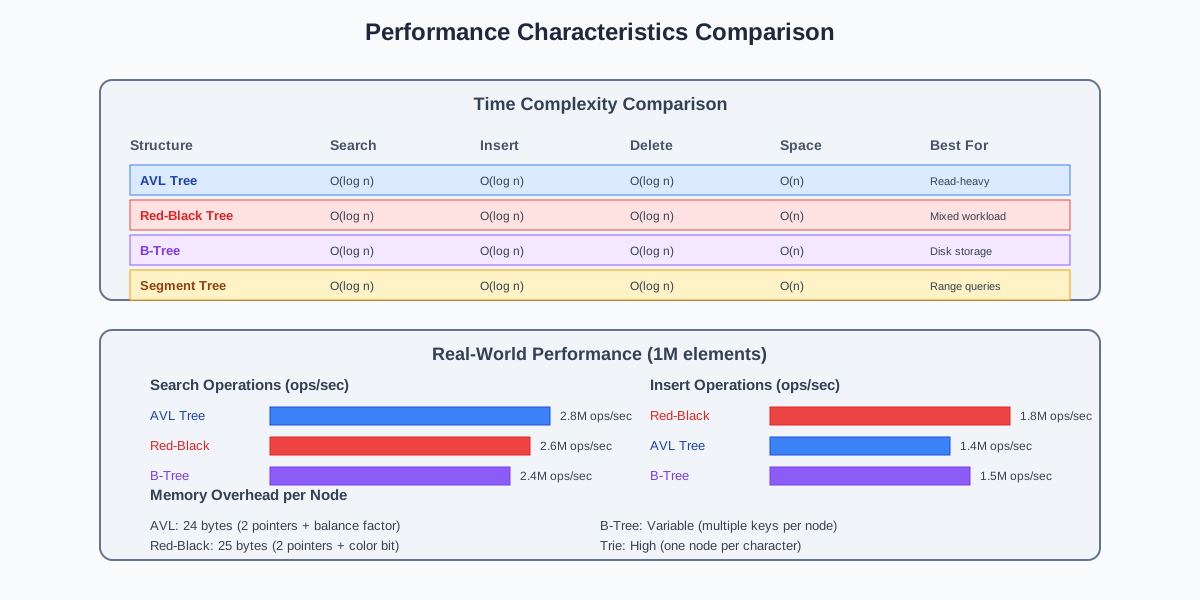
When to Use Which Tree
Use AVL trees when:
- Reads vastly outnumber writes
- You need guaranteed worst-case performance
- Memory isn’t a constraint
- Example: Dictionary implementations, read-heavy database indexes
Use Red-Black trees when:
- You have mixed read/write workloads
- You need good average performance
- You’re implementing a general-purpose sorted container
- Example: Standard library implementations, kernel data structures
Use B-trees when:
- Data lives on disk
- You’re building a database or file system
- You need range scans
- Example: Database indexes, file system metadata
Use Segment trees when:
- You need efficient range queries
- You have frequent updates
- You’re solving competitive programming problems
- Example: Range sum queries, interval scheduling
Use Tries when:
- You need prefix matching
- You’re implementing autocomplete
- You’re working with strings or sequences
- Example: Autocomplete, spell checking, IP routing
Interview Mastery: Recognizing Advanced Tree Problems
Technical interviews love advanced trees because they test deep understanding.
Keywords that suggest AVL/Red-Black trees:
- “Maintain sorted order with frequent insertions”
- “Balanced binary search tree”
- “Guaranteed logarithmic operations”
Keywords that suggest B-trees:
- “Disk-based storage”
- “Database index”
- “Minimize disk reads”
Keywords that suggest Segment trees:
- “Range queries”
- “Update and query intervals”
- “Sum/min/max over ranges”
Keywords that suggest Tries:
- “Prefix matching”
- “Autocomplete”
- “Dictionary of strings”
- “IP address lookup”
The decision framework:
- What operations do you need? (Insert, delete, search, range query, prefix match)
- What’s the access pattern? (Read-heavy, write-heavy, mixed)
- Where does data live? (Memory, disk, distributed)
- What are the performance requirements? (Worst-case, average-case)
Building Your Advanced Trees Intuition
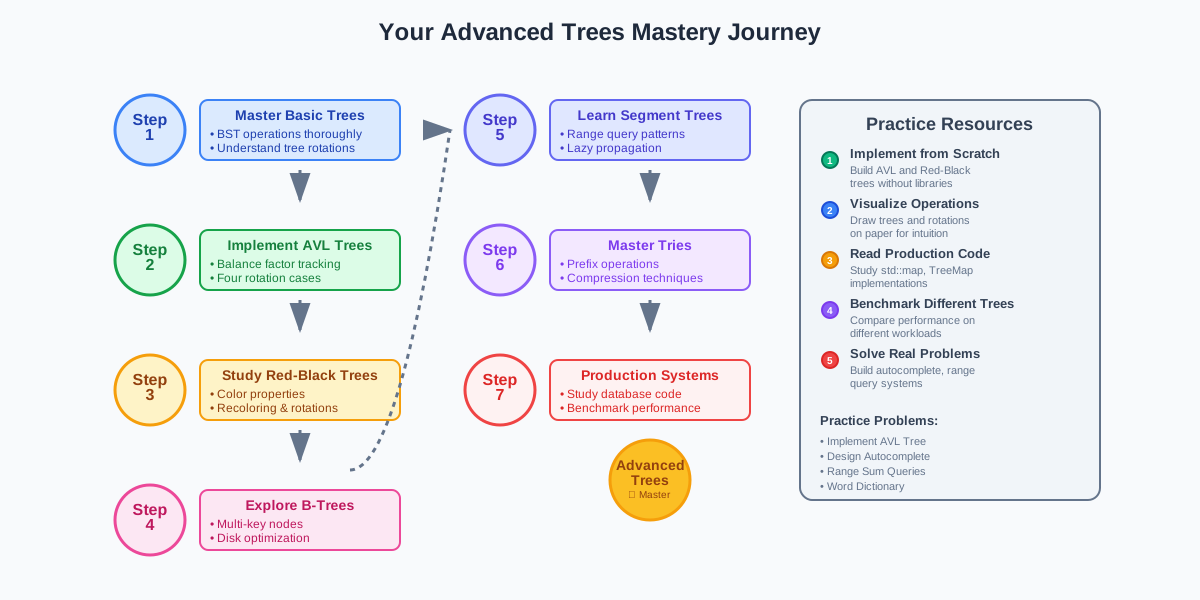
Understanding advanced trees takes practice. Here’s how to build intuition:
Visualize operations. Draw trees on paper. Perform insertions and deletions manually. See how rotations work. This builds muscle memory.
Implement from scratch. At least once, implement an AVL tree or Red-Black tree yourself. You’ll understand the invariants deeply.
Study production implementations. Read the source code of std::map in C++ or TreeMap in Java. See how experts handle edge cases.
Benchmark different structures. Create test programs comparing AVL, Red-Black, and B-trees. See how they perform with different workloads.
Solve problems. LeetCode, HackerRank, and Codeforces have excellent advanced tree problems. Practice until patterns become obvious.
The Future of Tree Structures
Tree structures continue evolving. New variants emerge for new problems.
Concurrent trees handle multi-threaded access without locks. Lock-free B-trees, concurrent skip lists—these enable high-performance parallel systems.
Cache-oblivious trees automatically adapt to any cache hierarchy. They perform well without knowing cache sizes.
Persistent trees maintain all historical versions efficiently. Used in version control systems and functional programming languages.
Probabilistic trees like skip lists trade deterministic guarantees for simpler implementation. Sometimes “probably balanced” is good enough.
Learned indexes use machine learning to predict key locations. Google’s research shows ML models can sometimes outperform traditional B-trees.
Key Takeaways
Advanced trees aren’t just faster versions of basic trees. They’re specialized tools for specific problems.
Self-balancing is essential for production systems. Never use basic BSTs where data order is unpredictable.
Different trees for different needs. AVL for reads, Red-Black for mixed workloads, B-trees for disk, Segment trees for ranges, Tries for prefixes.
Theory guides, practice decides. Benchmark your specific workload. The “best” structure depends on your data and access patterns.
Real-world systems use these structures everywhere. Databases, file systems, kernels, search engines—advanced trees are the invisible infrastructure of modern computing.
Master the fundamentals first. Understand basic trees and BSTs thoroughly before diving into advanced variants. The concepts build on each other.
Rotations are the magic. Understanding tree rotations unlocks understanding of all self-balancing trees.
What’s Next?
You’ve now seen the advanced tree structures that power modern systems. These aren’t just academic concepts—they’re battle-tested solutions to real problems.
Start by implementing an AVL tree from scratch. Feel the rotations, understand the invariants. Then move to Red-Black trees and see how the relaxed balance rules change the implementation.
Study how databases use B-trees. Read MySQL’s source code or PostgreSQL’s documentation. See how theory meets practice.
Build something with tries. Implement autocomplete for your project. Feel how naturally they solve prefix matching problems.
The best way to learn advanced trees is to use them. Find problems they solve, implement solutions, measure performance.
Want to discuss specific tree structure challenges or share your implementation experiences? Reach out—I’d love to hear about the problems you’re solving with advanced trees.
Remember: every fast database query, every instant autocomplete, every efficient file system operation—somewhere, an advanced tree structure is doing the heavy lifting.
Comments & Discussion
Join the conversation! Share your thoughts, ask questions, or provide feedback below.