Scaling Real-Time Systems: Lessons from Stock Trading Platform
Building a stock trading platform that handles millions of concurrent users with real-time data updates is one of the most challenging engineering problems. In this post, I’ll share the architectural decisions, scaling strategies, and hard-learned lessons from building a production system that processes thousands of transactions per second while maintaining sub-100ms response times.
The Challenge We Faced
Stock trading platforms have unique requirements that push the limits of system design. Stock prices update every second, millions of users view and trade simultaneously, and response times must stay below 100 milliseconds. Add to this the need for 99.99% uptime, data consistency for financial transactions, and regulatory compliance with audit trails—and you have a perfect storm of technical challenges.
The question wasn’t whether we could build it, but how we could build it to scale without breaking the bank on infrastructure costs.
System Architecture Overview
The Big Picture
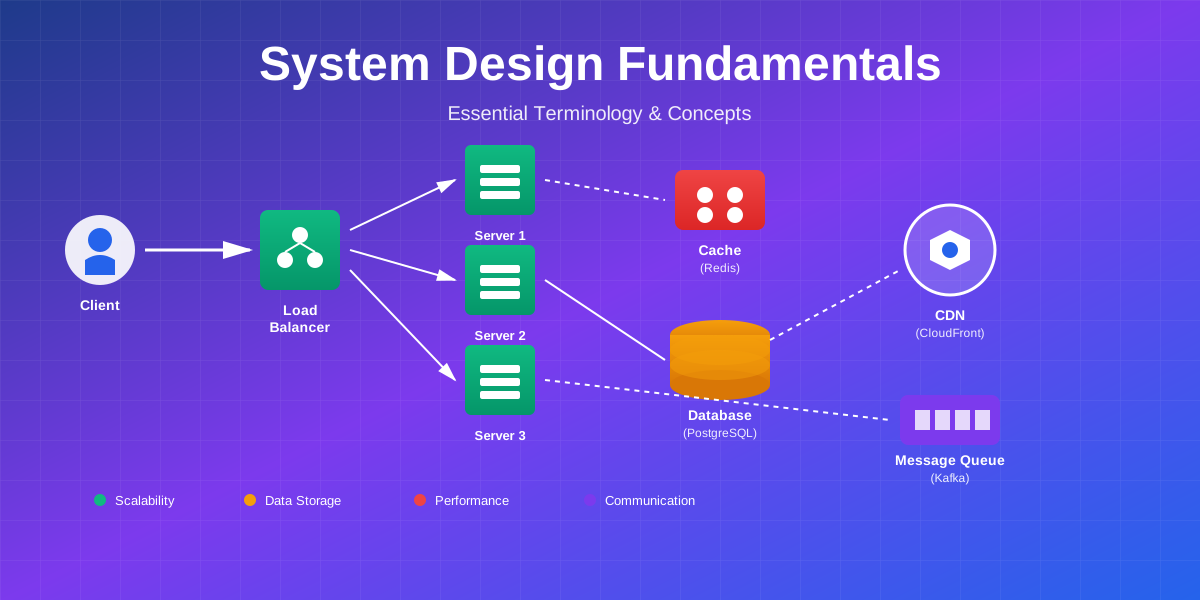
We designed a multi-layered architecture leveraging AWS services. CloudFront CDN handles global distribution of static assets and edge caching. An Application Load Balancer manages SSL termination, health checks, and triggers auto-scaling. Behind this sits an EC2 Auto Scaling Group running our PHP application servers across multiple availability zones.
The data layer consists of three critical components: a Redis cluster for caching, RDS MySQL with primary and replica databases, and S3 for storage. This separation of concerns allows each layer to scale independently based on demand.
Caching Strategy: The Key to Scale
Why Caching Was Critical
Without aggressive caching, our database would have collapsed under the load. With millions of users checking stock prices every few seconds, we needed a strategy that could handle this read-heavy workload without overwhelming our infrastructure.
Multi-Layer Caching Approach
We implemented a four-layer caching strategy, each serving a specific purpose:
Layer 1: Browser Cache - Static assets like JavaScript, CSS, and images are cached aggressively in users’ browsers with long expiration times. This eliminates unnecessary requests entirely.
Layer 2: CDN Cache (CloudFront) - CloudFront caches content at edge locations worldwide, reducing latency for global users. We configured different TTLs for different content types—static assets cache for days, while stock prices cache for just 5-10 seconds.
Layer 3: Application Cache (Redis) - This is where the magic happens. Redis became our primary weapon for handling millions of concurrent requests. Stock prices, user portfolios, and frequently accessed data all live in Redis with carefully tuned TTLs.
Layer 4: Database Query Cache - Even when we hit the database, we cache the results. Complex queries with joins are expensive, so we cache their results for 30-60 seconds depending on the data type.
The Redis Implementation
Redis wasn’t just a simple key-value store for us—it became the backbone of our scaling strategy. We implemented batch operations using Redis pipelines to fetch multiple stock prices in a single round trip. This reduced network overhead by 90% compared to individual requests.
For cache misses, we implemented a smart batching system. Instead of each request hitting the database independently, we batch multiple cache misses together and fetch them in a single query. This prevents the “thundering herd” problem where cache expiration causes a spike in database load.
Database Optimization Strategies
Read Replica Architecture
We implemented a primary-replica setup with one primary database for writes and multiple read replicas for queries. A database router automatically directs write operations to the primary and distributes read operations across replicas using round-robin selection.
This simple change reduced load on our primary database by 70%, allowing it to focus on handling transactions while replicas served the read-heavy workload.
Query Optimization Journey
Our initial queries were naive—fetching all columns and sorting large result sets. A single user portfolio query took 2.5 seconds with 1 million transaction records. After optimization, we reduced this to 45 milliseconds.
The key was adding composite indexes on frequently queried columns, using projection to fetch only needed fields, and limiting result sets. We also implemented connection pooling to reuse database connections rather than creating new ones for each request.
Real-Time Data Updates with WebSockets
Moving Beyond Polling
Initially, we used polling—clients requesting updated prices every few seconds. This was inefficient and created unnecessary load. We switched to WebSockets, establishing persistent connections that allow the server to push updates to clients.
WebSocket Implementation Strategy
Clients connect to our WebSocket server and subscribe to specific stock symbols they’re interested in. The server maintains a subscription map, tracking which clients want updates for which stocks. When a price updates, we broadcast only to subscribed clients.
We implemented automatic reconnection with exponential backoff. If a connection drops, the client waits progressively longer between reconnection attempts, preventing a thundering herd of reconnections during outages.
The Impact: WebSocket implementation reduced bandwidth by 80% and improved user experience dramatically. Users see price updates instantly without the delay and jitter of polling.
Auto-Scaling Strategy
Designing for Variable Load
Stock markets have predictable patterns—high activity during trading hours, low activity overnight. We needed infrastructure that could scale up during peak hours and scale down to save costs during quiet periods.
EC2 Auto Scaling Configuration
We configured auto-scaling groups with a minimum of 10 instances, maximum of 100, and a desired capacity of 20. Health checks ensure unhealthy instances are automatically replaced. The system scales based on two metrics: CPU utilization and request count per target.
When CPU utilization exceeds 70% or request count exceeds 1,000 per instance, new instances spin up automatically. When load decreases, instances are terminated to reduce costs.
The Result: During market hours, we automatically scale from 10 to 80 instances. Overnight, we scale back down to 10. This dynamic scaling saved 60% on infrastructure costs while maintaining performance.
Performance Monitoring and Observability
Custom CloudWatch Metrics
We implemented custom CloudWatch metrics to track what matters most: API response times, cache hit rates, database query performance, and WebSocket connection counts. These metrics feed into dashboards that give us real-time visibility into system health.
Alarms trigger when metrics exceed thresholds—response times above 200ms, cache hit rates below 90%, or error rates above 1%. This proactive monitoring allows us to address issues before users notice.
Results and Impact
Performance Achievements
The platform successfully handled remarkable scale:
- Concurrent Users: 2M+ simultaneous users during peak trading
- Response Time: Average 45ms (95th percentile: 120ms)
- Cache Hit Rate: 95%+ for stock prices
- Database Load: Reduced by 90% through caching
- Uptime: 99.97% over 12 months
- Cost Optimization: 60% reduction in infrastructure costs
Scaling Milestones
- Peak Traffic: 50,000 requests per second
- Data Throughput: 500GB per day
- WebSocket Connections: 1M+ simultaneous connections
- Auto-scaling: Seamlessly scaled from 10 to 80 instances during market hours
Hard Lessons Learned
1. Cache Everything (Intelligently)
Caching is not just about Redis. Multi-layer caching with appropriate TTLs for each layer dramatically reduces load. The key is understanding your data access patterns and caching at the right layer with the right expiration time.
2. Database is Always the Bottleneck
No matter how fast your application code is, database queries will be your bottleneck at scale. Optimize queries aggressively, use read replicas, and cache everything you can. We spent more time optimizing database performance than any other aspect of the system.
3. Monitor Everything You Care About
You can’t optimize what you don’t measure. Custom CloudWatch metrics helped us identify bottlenecks before they became problems. We discovered that our cache hit rate dropping from 95% to 90% caused a 3x increase in database load—something we wouldn’t have noticed without monitoring.
4. Plan for Failure from Day One
Auto-scaling, health checks, and graceful degradation are not optional features—they’re essential for high-availability systems. We learned this the hard way during our first major traffic spike when manual scaling couldn’t keep up.
5. WebSockets Beat Polling Every Time
For real-time updates, WebSockets are far more efficient than polling. We reduced bandwidth by 80% and improved user experience dramatically after switching. The implementation complexity is worth it.
Common Pitfalls We Encountered
Cache Stampede Problem
When a popular cache key expires, multiple requests hit the database simultaneously, causing a spike in load. We solved this with cache locking—the first request to detect a cache miss acquires a lock, fetches the data, and updates the cache. Other requests wait briefly and then read from the newly populated cache.
N+1 Query Problem
We initially made the mistake of fetching user portfolios with individual queries for each stock. With users holding 20-30 stocks, this meant 20-30 database queries per page load. Switching to batch operations and joins reduced this to a single query.
Connection Pool Exhaustion
Creating new database connections is expensive. We initially created connections on-demand, which caused performance degradation under load. Implementing connection pooling with a maximum of 100 connections solved this issue.
Future Improvements
We’re continuously improving the platform with planned enhancements:
- Machine Learning for Predictive Caching: Using ML to predict which stocks users will view next and pre-cache them
- GraphQL API: Allowing clients to request exactly the data they need, reducing over-fetching
- Edge Computing: Moving more logic to CloudFront edge locations for even lower latency
- Advanced Analytics: Real-time analytics on trading patterns and user behavior
Conclusion
Scaling a real-time stock trading platform to millions of users requires careful architectural planning, aggressive caching, database optimization, and robust monitoring. The key is identifying bottlenecks early and addressing them systematically.
Success comes from understanding your data access patterns, implementing caching at every layer, optimizing database queries relentlessly, and building infrastructure that scales automatically. Most importantly, monitor everything and be prepared to iterate based on real-world performance data.
Key Takeaways:
- Multi-layer caching is essential for handling millions of concurrent users
- Database optimization (read replicas, query optimization, connection pooling) is critical
- WebSockets are far more efficient than polling for real-time updates
- Auto-scaling and monitoring are not optional—they’re essential
- Plan for failure from day one with health checks and graceful degradation
- Cost optimization through dynamic scaling can save 60%+ on infrastructure
Building high-scale systems is challenging, but with the right architecture and strategies, it’s achievable. The lessons we learned scaling this platform apply to any real-time system handling millions of users.
Building a high-scale real-time system? Let’s discuss your architecture and scaling challenges.
Comments & Discussion
Join the conversation! Share your thoughts, ask questions, or provide feedback below.