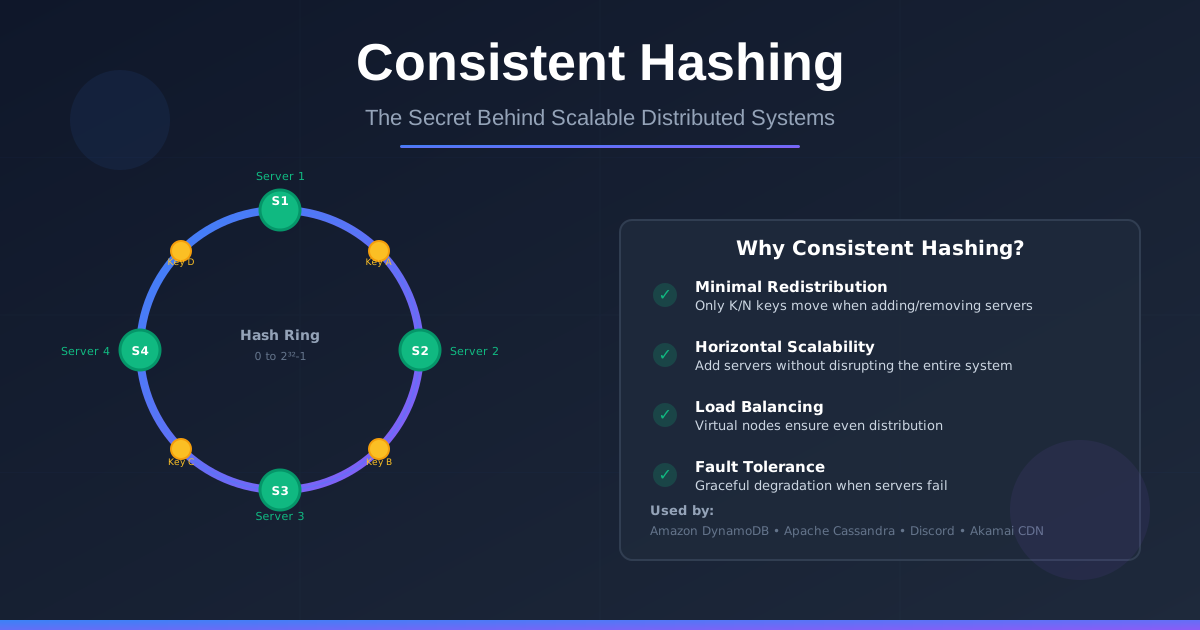
Consistent Hashing: The Secret Behind Scalable Distributed Systems
You’re running a successful web application. Traffic is growing. You add more cache servers to handle the load. Everything seems fine until… you deploy the new servers and suddenly your cache hit rate drops to nearly zero. Users are experiencing slow response times. Your database is getting hammered. What just happened?
This is the classic distributed systems problem that consistent hashing was designed to solve. And once you understand it, you’ll see why it’s used everywhere—from Amazon’s DynamoDB to Discord’s message routing to Netflix’s content delivery.
Let me show you why this algorithm is so elegant and how it can save you from scaling nightmares.
The Problem: Why Simple Hashing Breaks at Scale
Imagine you’re building a caching layer for your application. You have 3 cache servers, and you need to decide which server stores which data.
The naive approach? Use a simple hash function:
Server = hash(key) % number_of_servers
This works beautifully… until it doesn’t.
The Scaling Disaster
Here’s what happens when you add or remove a server. Let’s say you have 3 servers and you’re caching user profiles:
- User “alice” → hash(“alice”) % 3 = Server 1
- User “bob” → hash(“bob”) % 3 = Server 2
- User “charlie” → hash(“charlie”) % 3 = Server 0
Everything’s working great. Then traffic increases and you add a 4th server. Now:
- User “alice” → hash(“alice”) % 4 = Server 3 (was Server 1!)
- User “bob” → hash(“bob”) % 4 = Server 2 (same, lucky!)
- User “charlie” → hash(“charlie”) % 4 = Server 1 (was Server 0!)
Two out of three keys moved to different servers. The cached data is still on the old servers, but requests are going to new servers. Your cache hit rate just plummeted.
The Math Behind the Disaster
With simple hashing, when you change the number of servers from N to N+1 (or N-1), almost all keys get remapped to different servers. The percentage of keys that need to move is roughly:
Keys moved ≈ (N-1)/N × 100%
For 3 servers adding 1 more: (3-1)/3 = 67% of keys move For 10 servers adding 1 more: (10-1)/10 = 90% of keys move
This is catastrophic for caching systems. It means every time you scale, you lose most of your cached data and have to rebuild it from scratch. Your database gets hammered, response times spike, and users have a bad experience.
There has to be a better way.
Enter Consistent Hashing
Consistent hashing is an elegant solution that minimizes the number of keys that need to be remapped when servers are added or removed. Instead of remapping almost everything, it only remaps about K/N keys, where K is the total number of keys and N is the number of servers.
That’s a massive improvement. Let’s see how it works.
The Hash Ring Concept
Imagine a circular ring with values from 0 to 2³²-1 (or any large number). This is your hash space.
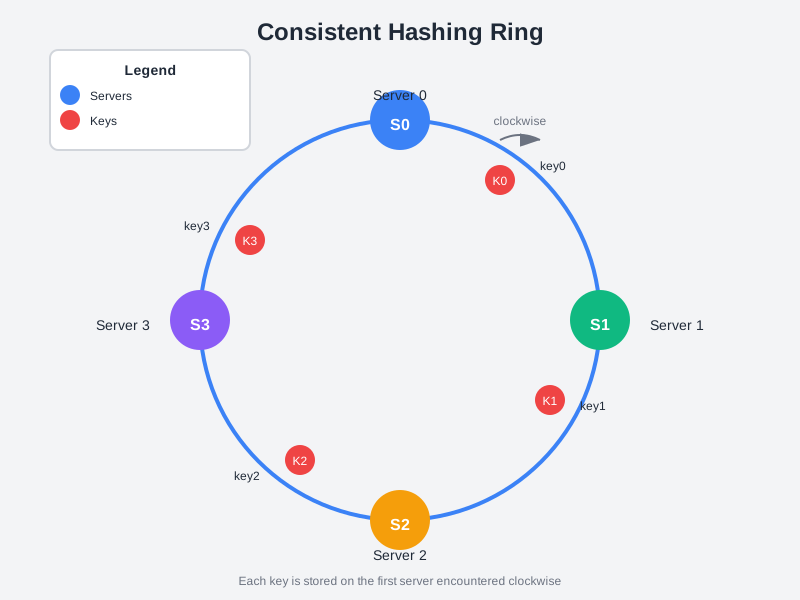
Here’s the magic:
- Hash your servers onto the ring using their IP address or name
- Hash your keys onto the same ring
- To find which server stores a key, move clockwise from the key’s position until you hit a server
That’s it. Simple, elegant, and it solves our scaling problem.
Why This Solves the Scaling Problem
When you add a new server to the ring, only the keys between the new server and the previous server (moving counter-clockwise) need to be remapped. All other keys stay exactly where they are.
Let’s see this in action.
Adding a Server: The Magic Moment
Imagine we have our three servers (A, B, C) on the ring, and we decide to add Server D. Here’s what happens:
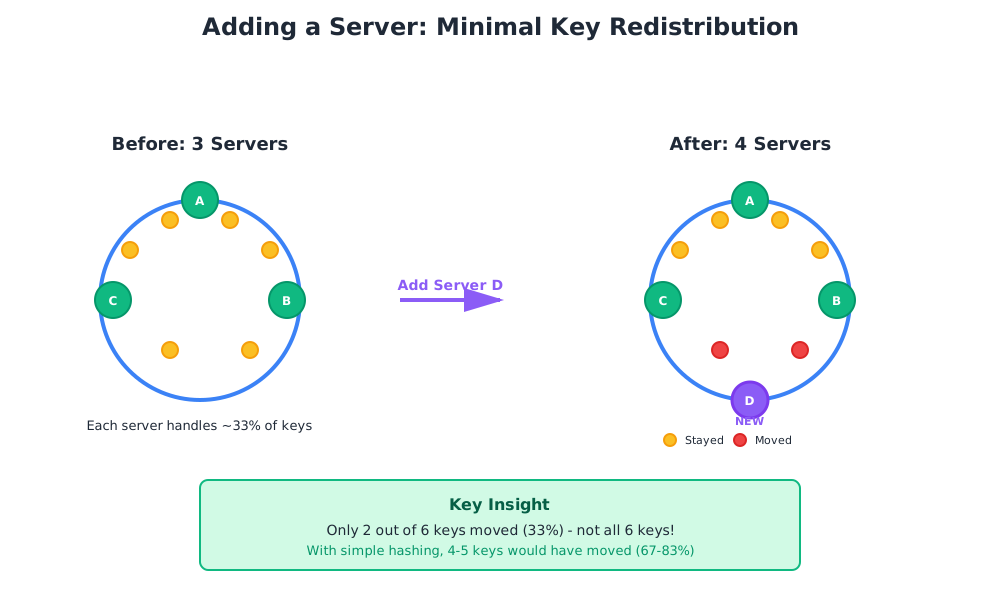
Server D gets hashed onto the ring. Let’s say it lands between Server B and Server C. Now, only the keys that were previously assigned to Server C but fall in the range between B and D need to move to Server D.
Everything else stays put.
This is the breakthrough. Instead of remapping 75% of your keys (like with simple hashing), you only remap about 25% (1/4 servers). And as you add more servers, the percentage gets even smaller.
With 10 servers, adding one more only remaps about 10% of keys. With 100 servers, it’s just 1%.
The Math That Makes It Beautiful
With consistent hashing:
- Keys moved when adding a server ≈ K/(N+1)
- Keys moved when removing a server ≈ K/N
Where K is total keys and N is number of servers.
Compare this to simple hashing where you’d move K×(N-1)/N keys. The difference is massive at scale.
The Virtual Nodes Solution
There’s one problem with basic consistent hashing: uneven distribution. If you only have 3 servers and they happen to hash close together on the ring, one server might end up handling 60% of the keys while another handles only 10%.
That’s not good for load balancing.
The solution? Virtual nodes (also called vnodes).
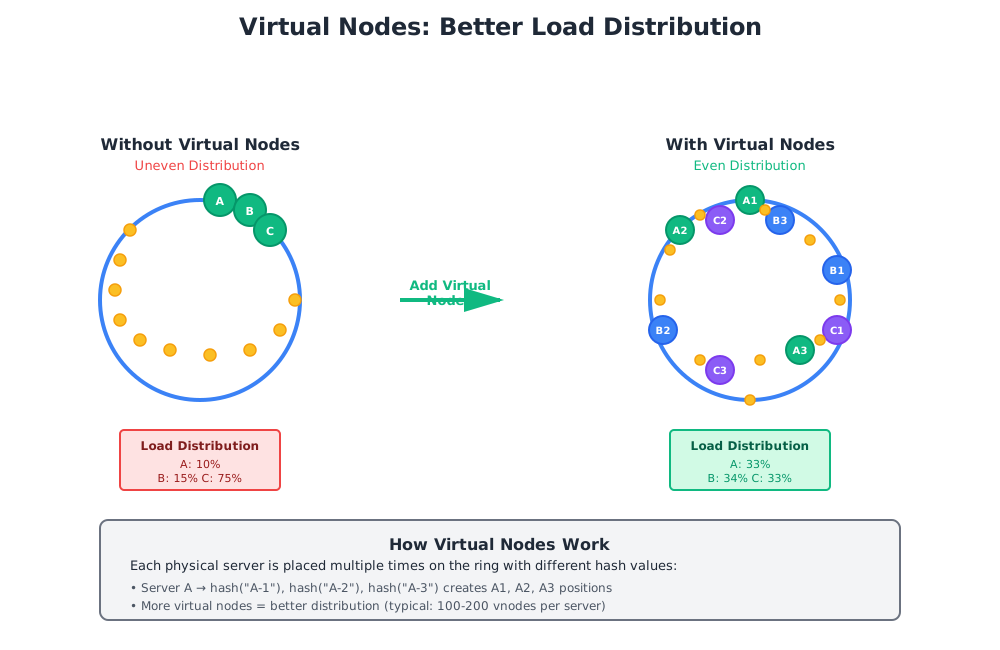
Instead of placing each physical server once on the ring, you place it multiple times using different hash functions or by appending numbers to the server name:
- Server A → hash(“A-1”), hash(“A-2”), hash(“A-3”), …
- Server B → hash(“B-1”), hash(“B-2”), hash(“B-3”), …
- Server C → hash(“C-1”), hash(“C-2”), hash(“C-3”), …
Now each physical server has multiple positions on the ring. This provides two huge benefits:
Better Load Distribution: With more points on the ring, the load naturally distributes more evenly. Instead of one server potentially handling 60% of keys, each server handles close to its fair share.
Smoother Scaling: When you add or remove a server, the impact is spread across multiple points on the ring rather than concentrated in one area.
Most production systems use 100-200 virtual nodes per physical server. Amazon’s DynamoDB uses 128 virtual nodes per node.
Real-World Applications
Consistent hashing isn’t just theoretical—it’s battle-tested in production at massive scale. Let’s look at where it’s used and why.
Amazon DynamoDB
DynamoDB uses consistent hashing to partition data across nodes. Each item’s partition key is hashed to determine which node stores it. When nodes are added or removed, only a small fraction of data needs to move.
This is how DynamoDB achieves its famous scalability—you can add nodes to handle more traffic without disrupting the entire system.
Apache Cassandra
Cassandra’s entire architecture is built around consistent hashing. The ring is divided into ranges, and each node is responsible for a range of hash values. When you add a node, it takes over part of the range from existing nodes.
This enables Cassandra to scale horizontally to hundreds or thousands of nodes while maintaining high availability.
Content Delivery Networks (CDNs)
CDNs like Akamai use consistent hashing to route requests to edge servers. When a user requests content, the URL is hashed to determine which edge server should handle it. This ensures that the same content is consistently cached on the same servers, maximizing cache hit rates.
Discord’s Message Routing
Discord uses consistent hashing to route messages to the right servers. With millions of concurrent users, they need to distribute load evenly while ensuring messages for the same channel always go to the same server.
Load Balancers
Modern load balancers use consistent hashing for session affinity. When a user’s session needs to stick to a specific backend server, consistent hashing ensures they’re always routed to the same server—unless that server fails, in which case they’re smoothly redirected to the next server on the ring.
Handling Server Failures
One of the beautiful aspects of consistent hashing is how gracefully it handles failures. When a server goes down, its keys are automatically redistributed to the next server clockwise on the ring.
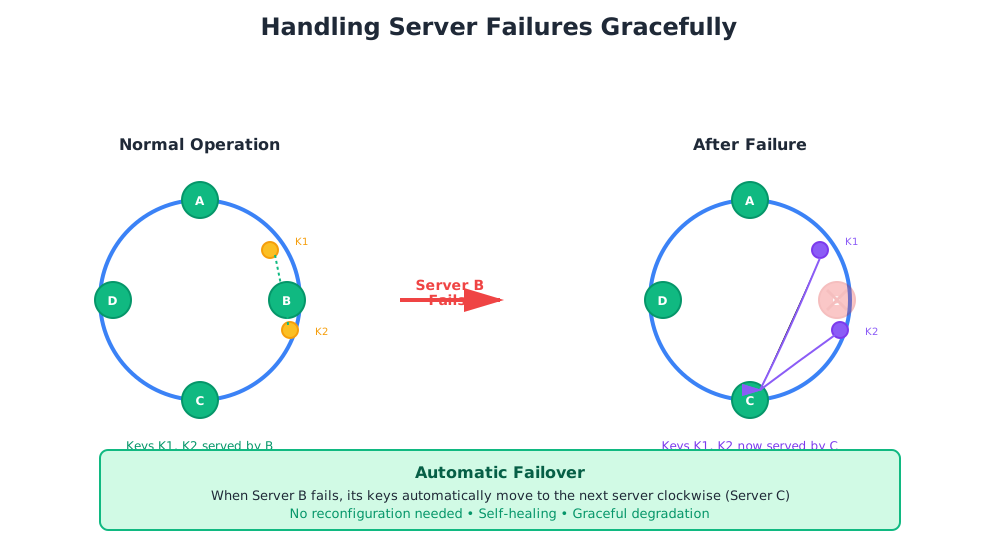
If Server B fails, all keys that were assigned to B automatically fall to the next server clockwise—let’s say Server C. No reconfiguration needed. No complex failover logic. It just works.
And when Server B comes back online, those keys naturally migrate back. The system self-heals.
This is why consistent hashing is perfect for distributed caches and databases where nodes can come and go dynamically.
Pros and Cons
Like any algorithm, consistent hashing has trade-offs. Let’s be honest about them.
Pros
✓ Minimal Redistribution: Only K/N keys move when adding/removing servers, not K×(N-1)/N
✓ Horizontal Scalability: Add servers without disrupting the entire system
✓ Fault Tolerance: Automatic failover when servers go down
✓ Load Balancing: Virtual nodes ensure even distribution
✓ Decentralized: No single point of failure or coordination needed
✓ Predictable: Same key always maps to same server (unless that server is down)
Cons
✗ Complexity: More complex than simple modulo hashing
✗ Virtual Nodes Overhead: Need to maintain multiple hash positions per server
✗ Cascading Failures: If one server fails, the next server gets all its load (can be mitigated with replication)
✗ Hotspots: Popular keys can still create hotspots on individual servers
✗ Not Perfect Distribution: Even with virtual nodes, distribution isn’t perfectly uniform
When to Use Consistent Hashing
Use it when:
- You need to scale horizontally by adding/removing servers
- You’re building a distributed cache or database
- You need session affinity in load balancing
- Servers can fail and you need automatic failover
- You want to minimize data movement during scaling
Don’t use it when:
- You have a fixed number of servers that never changes
- Simple modulo hashing is sufficient
- You need perfect load distribution (use other algorithms)
- The complexity isn’t worth the benefits
Implementation Considerations
If you’re implementing consistent hashing in your system, here are the key decisions you’ll need to make.
Choosing the Hash Function
You need a hash function that distributes values uniformly across the hash space. Common choices:
- MD5: Fast, good distribution, 128-bit output
- SHA-1: More secure, 160-bit output, slightly slower
- MurmurHash: Very fast, good distribution, popular choice
- xxHash: Extremely fast, excellent distribution
For most applications, MurmurHash or xxHash are great choices. They’re fast enough that hashing won’t be your bottleneck.
Number of Virtual Nodes
More virtual nodes mean better distribution but more memory overhead. The sweet spot for most systems is 100-200 virtual nodes per physical server.
Amazon DynamoDB uses 128 virtual nodes. Cassandra defaults to 256. Start with 150 and adjust based on your distribution metrics.
Data Structure for the Ring
You need an efficient way to find the next server clockwise from a key’s hash value. Common approaches:
Sorted Array: Simple, binary search is O(log N). Works well for up to thousands of servers.
Tree Map: O(log N) lookups, easy to add/remove servers. Most languages have built-in implementations.
Skip List: O(log N) average case, good for concurrent access.
For most applications, a tree map (like Java’s TreeMap or C++’s std::map) is the right choice.
Replication for Reliability
In production, you typically don’t want just one copy of each key. Store replicas on the next N servers clockwise from the primary.
If you want 3 replicas, store the key on the first server you hit, plus the next two servers clockwise. This way, if one server fails, you still have two copies.
Key Takeaways
Let me distill the essential points you should remember about consistent hashing:
- Consistent hashing solves the scaling problem by minimizing key redistribution when servers are added or removed
- Only K/N keys move when changing server count, compared to K×(N-1)/N with simple hashing
- The hash ring concept is elegant: hash both servers and keys onto the same ring, then move clockwise to find the server
- Virtual nodes solve the load distribution problem by placing each server multiple times on the ring
- It’s used in production by Amazon DynamoDB, Apache Cassandra, Discord, Akamai, and many others
- The algorithm handles server failures gracefully with automatic failover
- Trade-offs exist: added complexity for better scalability and fault tolerance
Conclusion
Consistent hashing is one of those algorithms that seems almost magical when you first encounter it. How can something so simple solve such a complex problem?
But that’s the beauty of elegant algorithms. They take a hard problem—how do you scale a distributed system without disrupting everything—and provide a solution that’s both practical and mathematically sound.
The next time you’re designing a system that needs to scale horizontally, remember the hash ring. It might just save you from a scaling nightmare.
Whether you’re building a distributed cache, a database, a load balancer, or any system that needs to partition data across multiple servers, consistent hashing gives you a proven path forward. Companies handling billions of requests per day rely on it. You can too.
Building a distributed system? Let’s discuss how consistent hashing can help you scale.


Comments & Discussion
Join the conversation! Share your thoughts, ask questions, or provide feedback below.